
If you have regularly followed my travel notes around Italy, you will surely have guessed that nothing excites me more than the dry sound of my boots hitting ancient stone. There is a precise moment, as I walk alone through the steep and shaded alleys of a historic village, when I physically feel the detachment from the present. Today I want to accompany you to a place that embodies this sensation in an absolute way, a place that seems less like a tourist destination and more like a space-time tear capable of throwing you directly into the 14th century: welcome to Gubbio.
I am Alessandro, and for us historians this town nestled in northern Umbria represents a true sanctuary of architecture. While the great flow of mass international tourism understandably crowds into nearby Assisi, on the trail of St. Francis, those looking for the proudest, most austere, and “real” face of the Italian Middle Ages come here.
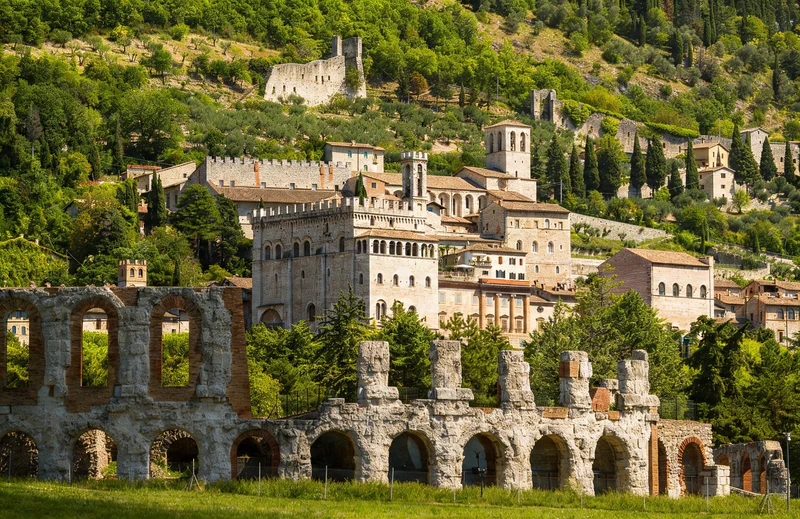
Gubbio is almost universally known as “The City of Stone.” And you only have to arrive at the foot of the village to immediately understand why. Update: If you’re looking to explore these rugged limestone slopes on two wheels, my colleague Martina has recently mapped out some incredible hidden MTB trails in the Umbrian Apennines starting right from these valleys. The city does not simply lean softly on the slopes of Mount Ingino; it seems instead to be born by parthenogenesis from the rock itself. The buildings, austere and without frills, are all strictly built in blocks of cold gray limestone.
The Piazza Suspended in the Void: Piazza Grande#
The beating heart of Gubbio’s civic power literally defies the laws of gravity. After facing the steep climb through the historic districts, you will suddenly find yourself coming out into Piazza Grande. This is not a normal town square, but a resounding masterpiece of 14th-century civil engineering.
It is a “hanging” square, an immense artificial terrace suspended in the void and supported from below by a complex and daring system of enormous masonry arches. Looking out from the parapet of Piazza Grande and watching the terracotta roofs sloping down towards the valley below is a breathtaking experience.
The Stone Giant: Palazzo dei Consoli#
Dominating this suspended terrace in an absolute and undisputed way is the Gothic bulk of the Palazzo dei Consoli. Built in the first half of the 1300s, it is one of the most imposing public buildings in Italy. Its crenellated profile and slender bell tower were visible from miles away. Today, entering its Sala dell’Arengo means entering the very belly of the city.
The Bronze Mystery: The Iguvine Tablets#
It is precisely inside the Palazzo dei Consoli that one of the most important linguistic treasures of the entire Western civilization is hidden: the Iguvine Tablets. Seven bronze plates that constitute the largest and most important text to reach us in the ancient Umbrian language. For a student of antiquity, observing them is an almost mystical experience. They describe a pagan world steeped in sacred rituals and magic that animated these hills centuries before Rome imposed its yoke on them.
The Spectacle of Antiquity: The Roman Theater#
Just outside the medieval walls, the stone changes shape and era. The Roman Theater of Gubbio, dating back to the 1st century BC, is one of the largest to have reached us from antiquity. Originally it could hold over six thousand spectators. Walking today among the remains of its imposing arches, immersed in the green of the Eugubian valley, offers a magnificent contrast with the severe verticality of the medieval village above. It is the perfect place to reflect on the infinite layering of Italian history.
The Dark Legend of the Door of the Dead#
Observing the facades of the ancient medieval houses, you will notice an architectural anomaly: many houses have a second door that is very narrow and positioned higher than the street level. This is the infamous Door of the Dead (Porta del Morto). Tradition holds that they were opened exclusively to take out the coffins of the deceased, to prevent the shadow of Death from “lingering” in the main entrance used by the living.
Strong Flavors: Truffles and Tradition#
Gubbio feeds the spirit, but does not forget the body. The Umbrian land here expresses itself with a rare intensity.
- The Gold of Gubbio: The white truffle of these hills is renowned worldwide. Enjoying it on a simple homemade tagliatella, perhaps in one of the small trattorias of Via dei Consoli, is an experience that reconciles you with the world.
- Crescia di Pasqua: Do not be fooled by the name; this tall and soft cheese savory cake is a delicacy that accompanies local cold cuts and pit cheeses in every season. It is the authentic flavor of the most genuine Umbria.
(Update: If the charm of cities trapped in time has captured you, I invite you to read my reports on Bevagna, the medieval time capsule and on the mysterious Volterra, the city of alabaster, two fundamental stops for those who love authentic history).
Gubbio is physical proof that in Italy history has never truly passed, but is the hard and cold limestone on which we place our feet daily.
See you soon, and prepare your calves for the climbs, Alessandro