
Hello everyone, I’m Luca. If there’s one thing I’ve learned from exploring the lesser-known parts of Italy, it’s that the most shocking beauty is often found not along the famous coasts, but where the earth cracks open and reveals its heart of tuff. While the crowds are elbowing each other for a square centimeter of beach on the Amalfi Coast, there is a place in the heart of Sannio that literally seems to float in the void. Welcome to Sant’Agata de’ Goti.
This village is not just a town; it’s a vision. Perched precariously on a ridge of volcanic tuff, between the valleys carved by the Martorano and Riello streams, rises a labyrinth of stone that looks as if it were carved by the hand of a giant. If you love driving through epic landscapes far from the traffic, I recommend checking out the iconic on-the-road itineraries that my colleague Marco has mapped out for those who, like us, live for the thrill of the open road.
The Martorano Bridge: Entering the Dream#
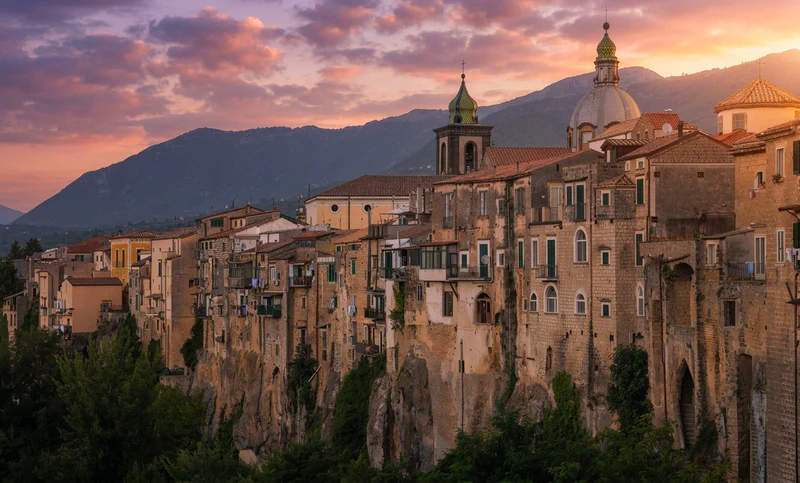
The best way to approach Sant’Agata is from the Martorano Bridge. Stop, turn off the engine, and get out of the car. What you will see is an uninterrupted wall of medieval houses that seem to sprout directly from the rock. There is no distinction between man’s work and nature’s: the gray tuff of the cliff becomes the yellow tuff of the houses in a chromatic harmony that takes your breath away.
At sunset, the cliff ignites with a warm orange, giving the illusion that the entire village is floating on a sea of fog or the forest below. It is an image that stays etched in the memory—a “floating fortress” that has defied gravity for centuries. If this kind of harmony between stone and history fascinates you, my colleague Alessandro recently revealed another lesser-known Italian treasure: the travertine dream of Ascoli Piceno.
Saticula and the Samnite Legacy#
The current name recalls the Gothic domination in the 6th century, but the soul of the village is much older and fiercer. Here stood ancient Saticula, a Samnite city that gave even the Romans a hard time. For those who know how to look beyond the 18th-century facades of the palaces, Sant’Agata reveals an ancient skeleton made of dry-stone walls and cyclopean foundations.
Did you know that the “Vase of Assteas,” considered by many to be the most beautiful vase in the world, was found right here? It represents the rape of Europa and is a symbol of the cultural refinement that this corner of Campania has expressed for millennia. Walking through the alleys of the historical center, which from above has the perfect shape of a musical semiquaver, means stepping on history at every turn.
The Belly of the Village: Cellars and Falanghina#
But the real magic of Sant’Agata is hidden beneath your feet. The village is literally a honeycomb of millenary cellars carved into the tuff. Here, fifteen meters deep, the temperature is constant all year round, creating the perfect microclimate for aging wine.
It is precisely in these caves that the Mustilli family rediscovered and bottled Falanghina in its purity for the first time, saving a grape variety that was in danger of disappearing. Visiting these cellars is a sensory experience: the smell of damp tuff mixes with the mineral fragrance of the wine. If this underground world piques your curiosity, Alessandro has dedicated an extraordinary guide to the secrets of Underground Naples, another tuff labyrinth that deserves to be explored.
Flavors of Sannio: The Annurca Apple#
You cannot leave without tasting the Annurca Apple PGI, the “Queen of Apples.” Unlike other apples, this one does not ripen on the tree but is harvested unripe and arranged on “melaiai” (straw beds) to redden slowly in the sun. This process gives it a unique aroma and crunchiness.
Ask in a local trattoria for a plate of handmade cavatielli with Sannio beef ragù, naturally accompanied by a glass of Falanghina. It is local cuisine that doesn’t need frills to amaze.
Luca’s Pet Peeves: It’s Not a Museum, It’s a Living City#
I want to share one of my biggest pet peeves: people who compare Sant’Agata de’ Goti to Civita di Bagnoregio. With all due respect to the “dying city,” Sant’Agata is a city that lives. Here, laundry is hung out of windows, the elderly discuss in the piazza, and craftsmanship is not a staged performance for tourists.
Update: I detest those who visit the village “hit and run,” stopping only at the bridge for a photo and rushing off towards the Royal Palace of Caserta. Sant’Agata requires time. It requires getting lost among its dead-end alleys, entering its Baroque churches, and listening to the sound of the wind in the valleys. For those looking for an equally dramatic on-the-road adventure further south, my colleague Marco has shared a guide to Cilento, another land of resistance and beauty.
Practical Tips for the Sannio Explorer#
- The Magic Moment: Arrive in the mid-afternoon. Explore the center in daylight, but make sure to be on the Martorano Bridge when the first lights of the evening are lit. The village will truly look like a stone ship setting sail into the night.
- Heart Coordinates: 41.088° N, 14.502° E (Bridge viewpoint). This is where your camera (and your heart) will work overtime.
- Logistics: Don’t try to enter the historic center by car unless you want to leave a mirror as a votive offering. Park in the outer area and walk. The village only reveals itself to those who traverse it on foot.
- My Secret Tip: Look for the Antica Osteria del Tufo. It’s not just a restaurant; it’s an immersion into the local gastronomic culture, where every ingredient has a name and surname of the producer.
Sant’Agata de’ Goti is proof that the brightest gems are often those that require a little extra effort to be found. It is an invitation to leave the beaten path, turn off the GPS, and let yourself be guided by the call of tuff and history.
Stay rebellious and keep searching for authenticity.
See you soon, Luca