
If you are a cyclist, or even just a fan of extreme sports, the name Piancavallo evokes images of pure suffering, sweat, and epic glory. It is here, in the wild heart of Friuli-Venezia Giulia, that the legendary Marco Pantani wrote one of the most incredible and dramatic pages in the history of the Giro d’Italia.
But Piancavallo is not just hot asphalt and thin tires; it is a gateway to an alpine world that most foreign tourists, and even many Italians, completely ignore. Situated on the edge of the Carnic Prealps, this plateau offers a vertical playground where physical challenge merges with primordial nature.
I am Martina, and today I am taking you to the heart of my favorite hunting ground. Don’t expect sweetened paths or glossy postcard views; here the mountain is real, rough, and demands payment in terms of oxygen and determination.
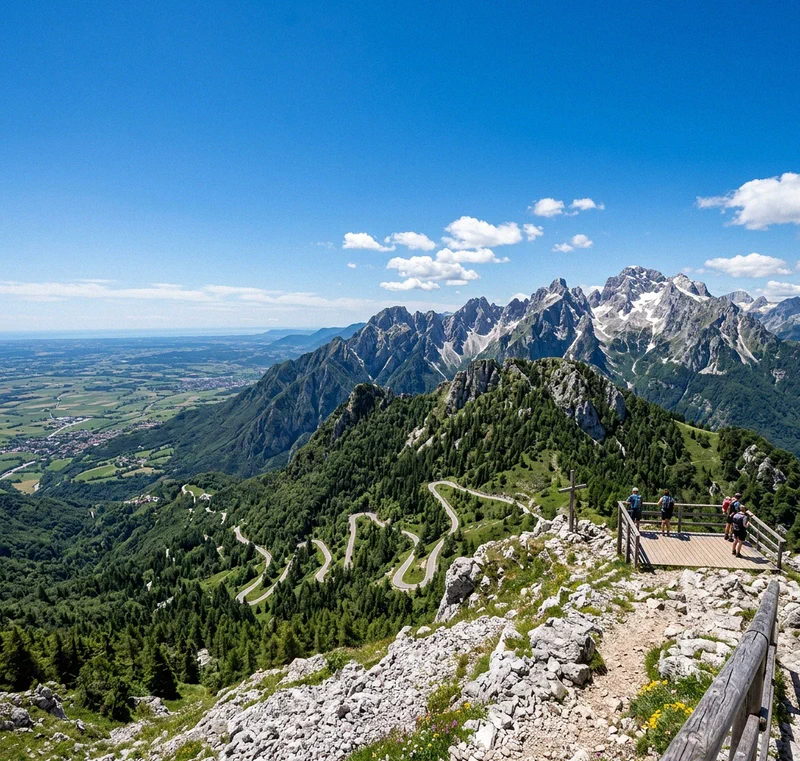
The Pirate’s Road: Anatomy of a Brutal Climb#
For anyone who loves two wheels, Piancavallo is a rite of passage. The 2026 Giro d’Italia will once again see riders tackle this iconic summit during one of the toughest stages of the Friulian “tappone.” It means facing 1,131 meters of positive elevation gain distributed over 14.5 kilometers, starting from Aviano. The average gradient is 7.8%, but cold numbers lie: this climb has a ruthless soul.
The first 6 kilometers are a true “hell,” with an average gradient of 9.4% and suffocating ramps that touch 11.6%. There is no moment to breathe. It is exactly on this asphalt that in 1998 “The Pirate” Marco Pantani performed his miracle. I still remember the images: him attacking, standing on the pedals, the bandana flying away, and his rivals seeming frozen in time. Pantani covered those final kilometers with a speed that still defies the physics of modern cycling.
If you are planning to come and see the “Corsa Rosa” live in 2026, I advise you to move well in advance. The logistics of a mountain stage are complex. My colleague Alessandro has prepared an essential guide for Giro d’Italia fans, which will explain how to position yourself on the hairpins without getting stuck in road closures.
Preparation for Amateur Cyclists: Martina’s Method#
Don’t show up at the foot of Piancavallo with flatland gears or without proper training. The mountain demands respect. If you want to reach the top with a smile (or at least without putting your foot down), follow these technical tips:
- Gearing: A 34x32 is the bare minimum. If you want to enjoy the view and not just suffer, a 34x34 will allow you to keep a decent cadence even on sections above 10%.
- Heat Management: The climb is completely exposed to the sun in its central part, as the beech forests thin out. On summer days, the asphalt temperature can exceed 40°C. Two 750ml bottles are the minimum requirement.
- Strategic Pacing: The secret is surviving the first half. Don’t try to imitate the professional’s attacks in the first 4 kilometers. Keep your heart rate under control, because the slope only gives some respite in the last three kilometers, as the road enters the plateau.
If you love legendary challenges and epic asphalt, you should also read the report by my colleague Marco, who explored the mythical hairpins of the Stelvio Pass. Both are “sacred” mountains, but while the Stelvio is a temple of world cycling, Piancavallo is a more secret and visceral cathedral.
Vertical Trekking: Cimon del Cavallo and Beyond#
Once you reach the ski resort, the asphalt ends and the kingdom of limestone begins. The Cavallo group offers over 30 kilometers of marked trails, perfect for those who want to test their calves off the saddle.
Monte Tremol and the Panoramic Ridge#
Trekking to Monte Tremol (2,007m) is an unmissable classic. It is a rewarding ascent following the CAI 918 trail. On clear northern wind days, when the air is crisp, the view is a miracle: the peaks of Austria to the north, the Dolomites to the west, and incredibly, the Venice lagoon to the south. You can even see the silhouette of ships in the Gulf of Trieste.
Cima Manera: The Challenge for Experts#
Cima Manera (2,251m) is the queen peak. It is not a trail for everyone. It is a path classified as EE (Expert Hikers) which includes sections of the Alta Via dei Rondoi. Here the exposure is real: you will walk on sharp ridges where the gaze drops for hundreds of meters.
- Martina’s Technical Note: I still see too many hikers tackling these gullies with low running shoes. Don’t do it. The karsic rocks here are as sharp as razors. You need high boots with a good Vibram sole to guarantee traction and ankle protection.
Recovery: The Flavors of the Friulian Mountains#
My approach to the outdoors is binary: you burn everything uphill to earn glory at the table. Friulian mountain cuisine is not made for those on a diet; it is a cuisine of resistance, caloric and deeply honest.
- Frico: It is the Friulian national dish. A potato and aged Montasio cheese cake, fried until it becomes crispy outside and stringy inside. It’s the best post-workout fuel in the world.
- Pitina: Typical of the nearby Val Tramontina, it is a meatball of chamois or sheep meat, smoked with beech wood and secret aromas. An ancient, wild, and persistent flavor.
The silence of Friuli and its untamed nature remind me of the ancestral energy found in the deepest Mediterranean. My colleague Sofia described this spiritual connection to the land beautifully when telling us about the summer solstice in the Sardinian hinterland. Although the landscapes are opposites, the bond with tradition is identical.
Piancavallo will give you nothing. Every meter must be conquered with head and heart. But when you arrive up there, with the wind blowing from the plain and the memory of the Pirate pushing you from behind, you will understand why this mountain is legend.
Safe travels and good training, Martina