
I’m sitting on a stone wall warmed by the sun, overlooking a valley that seems to belong to another century. Below me, the Riviera dei Fiori glitters with an electric and frenetic light, but up here, time has a different rhythm, made of silence and a stubborn will to exist. Most tourists who speed along the highway towards the casinos of Sanremo don’t even imagine that, just a few kilometers of tight curves away, there is a place that has defeated the dust of time. Welcome to Bussana Vecchia, the village that refused to die.
I’m Luca, and today I’m taking you to discover what I consider Italy’s most fascinating experiment in resilience. It’s not just a ghost village; it’s a cry of artistic rebellion launched against fate. If you love places that, like this one, seem to emerge directly from the rock and the past, I recommend reading my account of Pitigliano, the city of tuff that shares this soul of stone and mystery with Bussana.
Ash Wednesday 1887: The Day the Earth Trembled#
The fate of Bussana Vecchia changed forever on a winter morning, February 23, 1887. It was Ash Wednesday, and most of the inhabitants were in church for the service. At 6:21 in the morning, the earth shook with unprecedented violence. The earthquake razed much of the village to the ground, killing hundreds of people and transforming this medieval jewel into a pile of rubble.
The authorities declared the village uninhabitable and forced the survivors to abandon it, founding Bussana Nuova in the valley. For over seventy years, the old village remained at the mercy of nature. Ivy began to wrap around the broken bell towers, and lizards became the only inhabitants of the collapsed noble palaces. It seemed like the end, but the “ghost” still had something to say.
The Revolution of Dreamers: Clizia and the Commune#
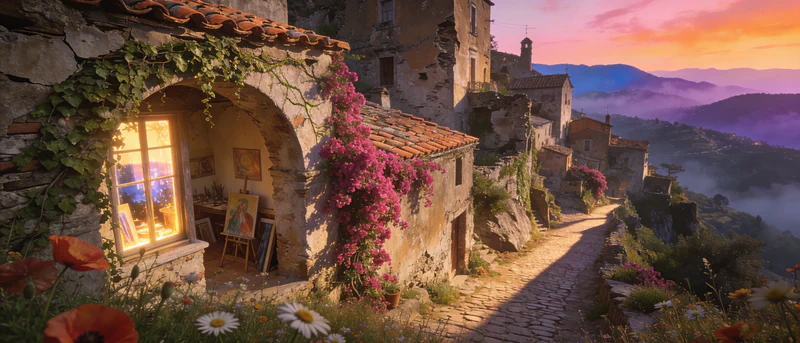
Everything changed in the 1960s when a Turin artist, Mario Giani (known as Clizia), had a vision. He was looking for a place far from the commercial art market, a place where creativity could flourish freely. Along with a handful of international artists, he decided to settle among the ruins of Bussana.
Without running water, electricity, or sewage, these pioneers began to rebuild the houses, scrupulously respecting the original structures. They founded the International Community of Artists, based on a simple but revolutionary rule: nobody owned the houses. One occupied the space necessary to live and create, and if one left the village, the house became available again for another artist. It was an experiment in freedom that still attracts dreamers from all over the world today.
What to See: A Labyrinth of Stone and Colors#
Walking through Bussana Vecchia today means getting lost in a labyrinth of caruggi where every corner is a work of art.
- The Church of Sant’Egidio: It is the symbol of the village. It was never rebuilt. If you peek through the iron gates, you’ll see the blue sky where the frescoed vaults once were. The remains of the stucco and pastel colors that resist the elements are a poignant sight.
- Ateliers and Workshops: You won’t find the usual “made in China” souvenirs here. Almost every open door is a studio where sculptors, painters, and leather artisans work live. It is the quintessence of true craftsmanship, which I always prefer in my travels.
- The Garden Among the Ruins: Some areas hit hardest by the earthquake have been transformed into spontaneous botanical gardens, where tropical flowers and succulents grow among the gutted walls, creating a surreal contrast between life and destruction.
If you want to live an experience where art and silence meet, come here with an open heart.
Luca’s Pet Peeves: It’s Not a Theme Park#
I want to be very frank with you, as I always am. One of my biggest pet peeves is seeing visitors treat Bussana Vecchia as if it were a film set or a Disneyland-style theme park. Bussana is a living community, with people who have fought for decades against the State to have their right to live among these stones recognized.
I detest those who arrive here and shout in the alleys or those who expect the comforts of a five-star hotel. You come here to feel the wind among the ruins, to smell the scent of linseed oil and wild jasmine. If you’re looking for polished perfection, stay in Sanremo. If instead you seek the wild soul that doesn’t surrender, you’re in the right place. I found this same rebellious energy exploring the lesser-known islands of Sicily.
The Explorer’s Secret: The Record Garden#
My secret tip is to climb to the highest part of the village, beyond the most frequented areas, and look for the “Record Garden” run by a local artist. It is a panoramic terrace decorated with old vinyl records and iron sculptures, from which you can enjoy a view over the valley and the sea that will make you feel on top of the world.
Come here at the golden hour, when the setting sun ignites the gray stone of the ruins and the shadows of the bell towers lengthen over the rebuilt roofs. It is the moment when the magic of Bussana explodes in all its strength and the day-trippers have already left, leaving the village to its electric silence. Heart Coordinates: 43.838° N, 7.828° E (Piazza della Chiesa).
Practical Advice for the Adventure#
- Access: Forget the car. Park at the bottom (there are few spots along the narrow road) and walk up. The climb is part of the initiation.
- Equipment: Trekking shoes or sneakers with good grip. The floors of Bussana are made of irregular stones a thousand years old and can be very slippery.
- Local Support: Eat at the Casaccia or the Osteria degli Artisti. Supporting these businesses means allowing the community to continue to exist and resist.
Bussana Vecchia reminds us that beauty can be born from ashes and that art is the highest form of human resistance. It is an invitation to never give up in the face of the inevitable and to build your own paradise where others see only ruins.
Update from the road: For those seeking a more spiritual immersion among the peaks of this region, I’ve recently added a note about my colleague Martina’s journey through the secret trails of Ligurian sanctuaries, a path that speaks to the same resilience I found in Bussana.
Stay rebellious and never stop dreaming the impossible.
See you soon, Luca