
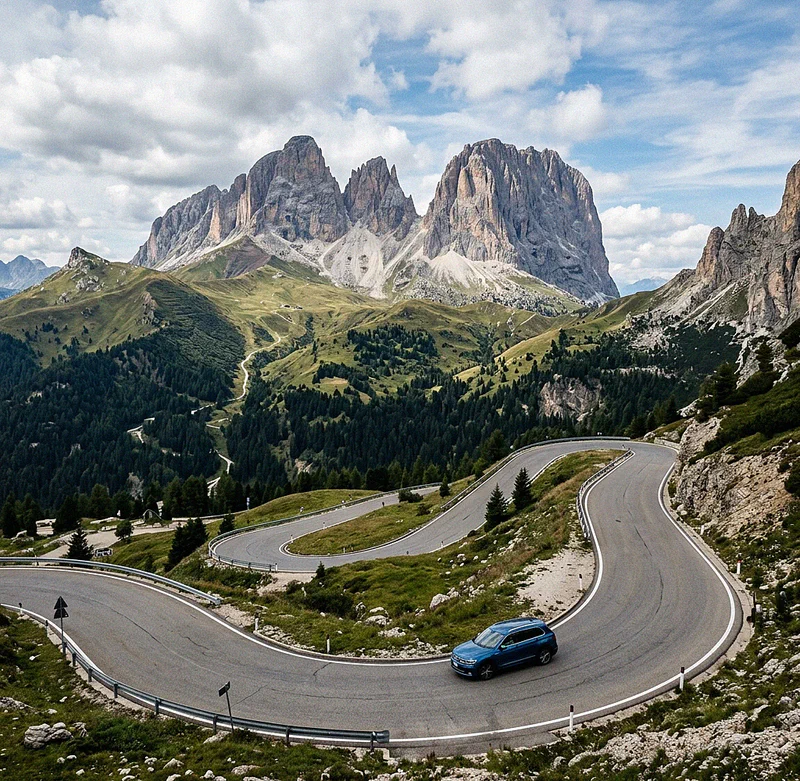
Some people go to the mountains to ski, others go to hike. And then there’s us: the ones who go to feel the tires grip the perfect asphalt and hear the whistle of the turbo working in the thin air. The Great Dolomite Road (SS48) is not just a scenic route; it’s an engineering masterpiece completed in 1909 that every driving enthusiast should experience at least once.
Update: I’m Marco, and for me, happiness is measured in degrees of incline and the number of hairpins. We are talking about 110 kilometers of pure alpine ecstasy stretching from Bolzano all the way to Cortina d’Ampezzo. Update: For those who want to leave the car behind and experience these vertical walls from a truly extreme perspective, my colleague Martina has recently shared her conquering of the most challenging Via Ferrata in this very massif. It’s a route I consider the beating heart of my most iconic Italian road trips.
The Machine: Choose Your Steed#
Before you hit the SS48, let’s talk about your vehicle. If you’re driving in the Dolomites, you need torque—lots of it. You’ll be climbing from 262 meters in Bolzano to over 2,200 meters at the Pordoi Pass. For my last trip, I chose an Alfa Romeo Giulia: a low center of gravity and rear-wheel drive are the secrets to “hugging” these curves.
The 27 hairpins of the Pordoi’s western ascent require surgical steering. If you’re traveling with a family, an SUV with a good diesel engine or a snappy hybrid is fine, but avoid small naturally aspirated cars that struggle with 12% gradients. If you want to test your reflexes on something even more extreme, check out my masterclass on the Strada della Forra.
Leg 1: The Alpine Awakening at Carezza#
Start early, preferably by 7:30 AM. My advice is to stay ahead of the tour buses that, around 10:00 AM, turn the road into a motionless metal snake. Your first stop is Lake Carezza (Lago di Carezza).
- Strategic Stop: 46.409° N, 11.575° E (Official parking). Don’t try to park on the main road; the Carabinieri are merciless.
- The View: The Latemar massif reflecting in the water is breathtaking. While you enjoy the show, remember that this is the gateway to a vertical world. If after all this rock you crave the peace of fresh water, follow Sofia’s advice for a romantic escape to Lake Orta.
Leg 2: The King of Passes – The Pordoi#
This is why we’re here. From Canazei, the road starts to twist like a plate of spaghetti. You are on the SS48. The Pordoi Pass is the highest point at 2,239 meters.
Marco’s Technique: Downshift before the turn. Use second gear for the apex and, as soon as you see the exit, open the throttle smoothly. On the way down, use engine braking so you don’t “cook” your brake discs. If you smell burning, stop and admire the view. You might think about how much easier it would have been to go skiing in Bormio, as Elena suggests, but you are here for the asphalt.
Marco’s Pet Peeves: Snail-Paced Campers and Fuel Costs#
I want to be honest about what drives me crazy (my pet peeves): the XXL motorhomes trying to climb the Pordoi at a snail’s pace. Guys, if you can’t handle tight hairpins, take the shuttle! You block the driving pleasure for everyone and create miles of queues under the alpine sun.
And then there’s fuel. Filling up at the top of the passes is financial suicide. Fill up in Bolzano or Canazei. Look for “Self” stations to save those 20-30 cents per liter that you can invest in a good mountain hut lunch.
Toward Cortina: The Falzarego Pass#
After Arabba (a mandatory stop for a slice of cake), the climb to the Falzarego begins. Watch out for cyclists: the Dolomites are their temple. Overtake them only when you have visibility and always leave plenty of space. If the parking at the top is full, continue for a kilometer toward the Valparola Pass. It’s often emptier and the view of the Sass de Stria is even wilder. This sense of freedom reminds me of the road to Campo Imperatore in Abruzzo, another paradise for drivers.
Final Survival Tips#
- Right of Way: Those driving uphill generally have the right of way on narrow sections. But if you see an old local 4x4 Panda flying down the mountain, pull over. They don’t brake.
- Offline Maps: Download them. Between the Sella rock walls, the GPS signal plays hide and seek.
- Dinner in Cortina: Go to Ristorante Al Camin. It’s away from the center’s chaos, has good parking, and their casunziei (beetroot pasta) are the perfect fuel after 110 km of curves.
The Great Dolomite Road is not a trip; it’s a test of character. Shift into the right gear, respect the mountain, and keep your eyes on the road.