
Losing yourself intentionally along the backroads of the lower Po Valley, in that patch of fertile and misty land located in the far south of Lombardy—just a short distance from the wonders of the Gonzaga court—you come across a place that defies logic.
It is not simply a picturesque agricultural village that grew over centuries around a bell tower.
It is rather a mathematical mirage, a philosophical dream suddenly made solid through the masterful use of millions of terracotta bricks, white marbles, and absolute military geometries. Today I want to accompany you across the gates of Sabbioneta.
I am Alessandro, and for a lover of architectural history like me, this place represents a sort of Holy Grail of urban planning. Nicknamed the “Little Athens” by its own contemporaries, Sabbioneta did not evolve organically over time: it was born already adult, already perfect, projected like a movie set in the middle of the countryside by the precise order of a single visionary man.
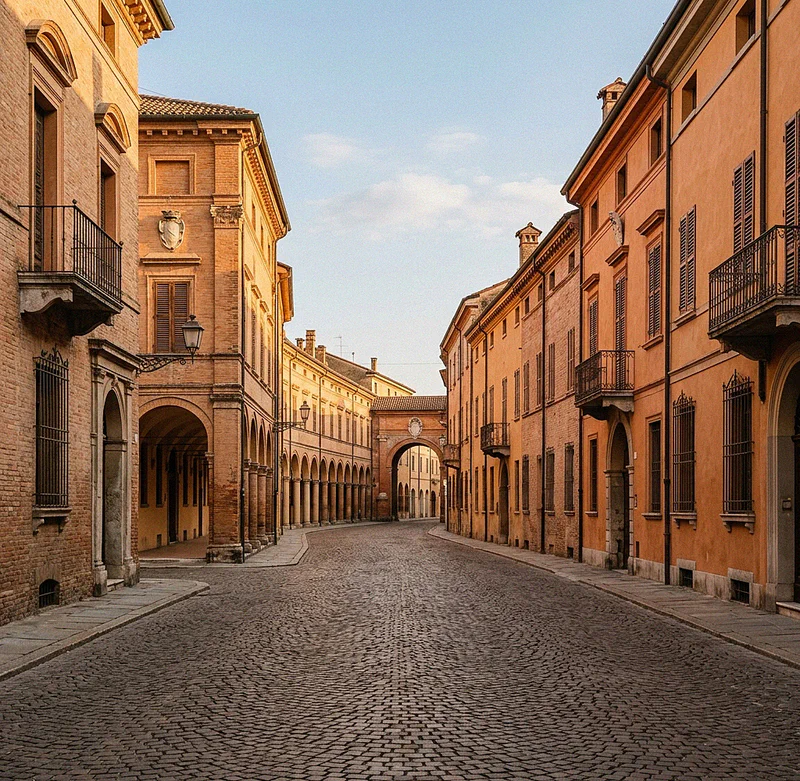
Built entirely from scratch on previously swampy ground between 1554 and 1591, Sabbioneta is the physical realization of the “Ideal City” envisioned by Renaissance humanists. This profound connection to the Gonzaga court—which I’ve explored in depth during my journey through Mantua, the hidden Renaissance jewel of Lombardy—is essential to understanding the sheer audacity of this project.
The Ducal Obsession of Vespasiano Gonzaga#
But who could have the arrogance, the power, and above all the money to found an independent capital from nothing?
The name of this demiurgic creator is Vespasiano Gonzaga Colonna. Duke, military commander in the service of the powerful Emperor Philip II of Spain, and refined humanist intellectual.
Vespasiano had a true personal obsession: he wanted to prove to the whole world that he could shape the definitive urban planning. Sabbioneta had to be impregnable as a modern military fortress, yet elegant, harmonious, and perfect like imperial Rome. Entering one of its mighty gates, set in a spectacular star-shaped hexagonal defensive wall, you immediately realize that here nothing, absolutely nothing, was left to chance.
The Deception of Asymmetric Squares#
The street layout is based on the classic orthogonal intersection (cardo and decumanus), but with a disconcerting feature studied at the drawing board: the two main squares (Piazza Ducale and Piazza d’Armi) are not perfectly symmetrical, and the main streets never offer a clear view from one city gate to another.
This brilliant “flaw” intended by Vespasiano had a very precise military purpose: to prevent an invading enemy army, should they manage to breach the gates, from sweeping the entire city by firing straight with artillery or charging with cavalry in an open field.
The Treasures of a Pocket Court#
Although the city’s size is that of a tiny provincial village (today it counts fewer than 4,500 inhabitants in the municipal territory and a few hundred within the walls), the public buildings commissioned by Vespasiano for his small capital are of unheard-of sfarzosità.
The Triumph of Perspective: The Teatro all’Antica#
The true jewel of Sabbioneta, which alone justifies the trip, is the famous Teatro all’Antica.
Designed in 1588 by the Vicentine architect Vincenzo Scamozzi (Palladio’s spiritual heir and pupil), this is not a theater housed inside a pre-existing palace. It is, strikingly, the first permanent theater building built in Europe specifically and exclusively for that purpose in the modern era.
Entering it, you remain literally open-mouthed before the magnificent semi-circular loggia, supported by elegant Corinthian columns and topped by imposing polychrome wooden statues depicting the deities of the Roman Olympus, who seem to observe the audience from above.
The Palazzo del Giardino and the Gallery of the Ancients#
Exiting the theater and crossing the austere Piazza d’Armi, you come across the Palazzo del Giardino.
This was Vespasiano’s personal “pleasure villa,” an intimate place for rest, reading, and escape from government duties. Its interior rooms, completely and densely frescoed by masters of the Bernardino Campi school, are an uninterrupted succession of classical myths, stories of Roman heroes, and complex perspective games.
But it is what the palace is connected to that leaves you breathless: the Gallery of the Ancients.
This impressive and very long porticoed corridor, extending for almost a hundred meters in length, is an authentic triumph of Renaissance perspective. Flooded with natural light thanks to continuous windows, the gallery was built with a single and very expensive purpose: to house the vast and priceless collection of ancient Greek and Roman busts, sculptures, and marbles that the Duke had methodically purchased throughout his life.
(Update: This total Renaissance obsession with the physical manipulation of space and perfect green geometries does not stop in Lombardy. If you are fascinated by this world, an in-depth investigation of mine will be released in a couple of months dedicated precisely to finding the private courtyards and inaccessible secrets of the Gardens of Florence, the beating heart of this cultural revolution).
Suspended Time Under the UNESCO Shield#
Today, together with its larger “sister” Mantua, Sabbioneta is proudly inscribed on the UNESCO World Heritage list.
But, unlike the large art cities stormed by tourists in search of quick selfies, Sabbioneta has remained a silent, empty, and proudly metaphysical city. Walking through its wide cobbled avenues on cold and damp winter afternoons, when the dark and sharp silhouettes of the patrician palaces are partially swallowed and blurred by the classic Po Valley fog, is a very powerful sensory experience.
In those moments of solitude, time seems to have literally frozen and stopped abruptly at the end of the sixteenth century. It almost seems possible to breathe the unbridled and melancholic ambition of a single man, tormented, alone, yet stubborn in wanting to make his name immortal by bending the earth itself to the cold perfection of architecture.
Flavors of the Frontier: Cuisine Between the Gonzaga and the Po#
Sabbioneta is not only a feast for the eyes but also for the palate. Its position, straddling Mantua, Parma, and Cremona, has generated a culinary tradition that reflects the nobility of the courts and the concreteness of the Po Valley land.
You cannot leave the city without tasting the Tortelli di Zucca (Pumpkin Tortelli), the gastronomic banner of the Gonzaga. As I mentioned when speaking of the beating heart of Mantua, this dish is a miracle of balance between the sweetness of the pumpkin, the spiciness of the mustard, and the saviness of the Parmesan. If you are fascinated by how the pumpkin became the culinary gold of these lands, my colleague Giulia recently shared a delightful guide dedicated to the velvety gold of Ferrara, where she explores a similar tradition but with a typically Estense soul.
Alessandro’s Practical Tips#
Sabbioneta is a fragile jewel and should be explored with the right mental attitude.
- The Ducal Passport: As soon as you enter the city gate, go to the tourist Infopoint. Purchase the single cumulative ticket immediately. It will allow you to access all the historic palaces, the theater, and the galleries.
- The Sunset Light: Sabbioneta is built almost entirely with exposed terracotta bricks. This means the most magical and photogenic moment to admire its external architecture is late afternoon. The low, golden light of sunset hits the clay and literally sets the palaces on fire.
Sabbioneta is the living proof, cold but beautiful, that sometimes the craziest dreams of grandeur can turn into immovable stones that defy the centuries.
See you soon, Alessandro