
If I had to choose a place that perfectly embodies the concept of “cultural resistance” in Italy, that place would be Bevagna.
While most Umbrian villages climb vertiginously on the hilltops to defend themselves from the centuries, Bevagna sits with an almost defiant elegance in the valley, nestled in the plain where the Clitunno once flowed and where the Via Flaminia traced the destiny of Rome towards the North.
I am Alessandro, and as a historian, I have learned that the cities that do not shout are the ones that have more things to tell. Bevagna does not have the vertical spectacularity of Assisi or the monumental rigor of Perugia, but it possesses something much rarer: a vital and uninterrupted continuity between its Roman past, its medieval flourishing, and its artisan present.
In this article, I want to take you beyond the surface of conventional tourist guides, revealing why Bevagna is, in my opinion, the most authentic “time capsule” you can visit in 2026.
The Anomaly of Piazza Silvestri: A Perfect Disorder#
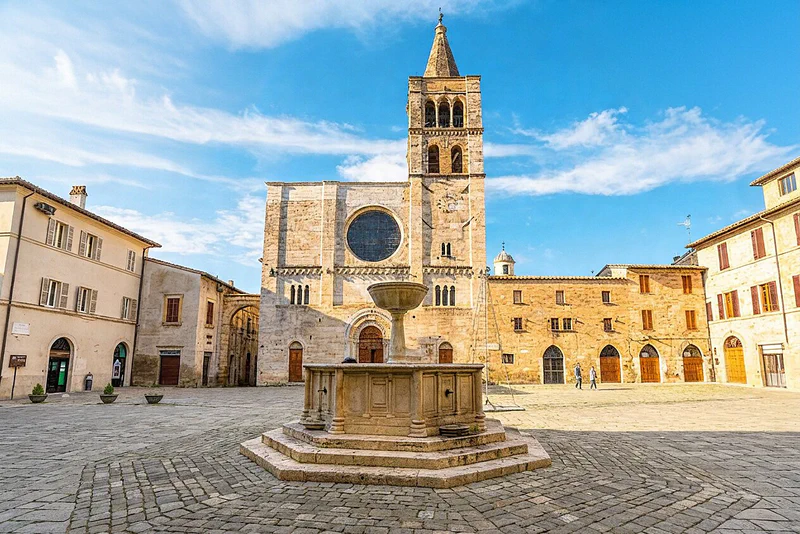
The beating heart of Bevagna is Piazza Silvestri. If you are used to the rigid symmetry of Renaissance squares or Baroque theatricality, this space will initially leave you disoriented.
There is no geometric center. There is no dominant visual axis. It is a triumph of medieval asymmetry that, paradoxically, generates an absolute harmony. Here, civil and religious power do not face each other with detachment but seem almost to touch in an embrace of limestone.
The Palazzo dei Consoli, with its imposing staircase leading to a covered loggia (now home to a 19th-century theater), stands side by side with the Church of San Silvestro and the Cathedral of San Michele Arcangelo. Entering San Silvestro, your breath stops. The interior is naked, austere, with exposed stones and a raised presbytery that seems still to await the Gregorian chants of the 12th century.
This search for such a dense and spiritual atmosphere is a distinctive feature of the great Umbrian centers that have managed to preserve their original face against the wear and tear of modernity. (If you love cities that have made stone their armor and their pride, I recommend reading my in-depth look at Gubbio and its medieval mysteries, a place that shares the same ancestral soul with Bevagna).
Mevania: The Roman Ghost Beneath Your Feet#
Bevagna was not born medieval. Before the knights and monks, there were the Romans, who called it Mevania. Thanks to its strategic position on the Flaminia, the city became a river port and a lively municipality.
Today, to find imperial Rome in Bevagna, you have to know how to look “inside” the houses. Many cellars in the historic center reuse the structures of the Roman theater from the 2nd century AD, which could hold up to ten thousand spectators. But the real archaeological gem is hidden in a small, secluded room: the Roman Bath Mosaic.
It is an extraordinary work in black and white tiles depicting a fantastic marine world: tritons, dolphins, lobsters, and aquatic monsters that almost seem to move when observed under the right light. It is a fragment of Roman daily life left intact, a testament to the wealth of a center that was not just a passing point but a place of well-being and culture.
The Mercato delle Gaite: Where Craftsmanship Becomes Living History#
What makes Bevagna unique in the world, however, is not just its architecture, but the ability of its inhabitants to keep alive crafts that elsewhere have disappeared for centuries. This happens thanks to the Mercato delle Gaite (the four medieval districts of the city).
Although the main re-enactment takes place in June, many workshops remain active year-round for educational and productive purposes. Entering these laboratories is not a museum visit; it is a raw and fascinating sensory experience.
- The Paper Mill (La Cartiera): Here I saw cotton and linen rags transformed into precious “bambagina paper” using 14th-century techniques. The noise of the hammers moved by water and the scent of wet fiber take you instantly back to another millennium.
- The Silk Factory (Il Setificio): Bevagna boasts one of the few laboratories in Europe where you can admire a human-powered mill from the 1300s for silk twisting. Seeing cocoons transform into shiny threads with wooden machinery is a miracle of pre-industrial engineering.
- The Candle Workshop (La Cereria): Here beeswax is worked with the “giro” method, creating candles through manual layers that require almost mystical patience and skill.
This dedication to authenticity and raw material is the same that I found exploring the gastronomic traditions of other great Italian cities of art, where the search for “handmade” has become a true cultural mission. (If this approach fascinates you, you cannot miss my colleague Giulia’s guide to Bologna’s secret pasta passages, where I reveal where to still find pasta rolled with a rolling pin as it was centuries ago).
Practical Tips for 2026: How to Experience Bevagna Like an Insider#
To fully enjoy Bevagna, forget the clock. The village must be walked slowly, getting lost in the alleys that lead towards the Topino river.
- Food and Wine: Bevagna is the land of Sagrantino di Montefalco. It is not a wine for everyone: it is powerful, tannic, deep. Pair it with handmade strangozzi seasoned with black truffle or with the local porchetta, which here is masterfully flavored with wild fennel from the Umbrian valleys.
- The Walls: Don’t limit yourself to the center. Walk the entire perimeter of the medieval walls, still almost entirely intact. They offer a unique perspective on the city’s defensive structure and the gates that once regulated the flow of goods and pilgrims.
- The Magic Moment: A misty Tuesday morning in November or an early spring evening. When the weekend tourist crowds disappear, Bevagna returns to being a silent city, where the only sound is the water flowing in the canals and the tolling of the bells of San Michele.
Bevagna teaches us that history is not a relic to be observed under a glass case, but a heritage that continues to breathe through the hands of those who still know how to work paper, silk, and stone.
It is an invitation to slow down and rediscover the beauty of things that last.
Happy time travel, Alessandro