
If you have ever walked through the vibrant, chaotic, and wonderfully loud streets of Naples, you know well that the city is a continuous sensory explosion. But the most fascinating version of Naples is not the one you see, but the one that lies exactly forty meters beneath your feet.
It is the Naples of tufa. A labyrinth of colossal cavities that for millennia has provided the raw material to build the city above, simultaneously transforming into a vital water reserve, a place of prayer, and, in the darkest moments of our modern history, a protective womb against destruction.
I am Alessandro, and today I want to invite you to descend with me into what I consider the largest and most complex underground historical archive in Europe. In 2026, Naples Underground is not just a tourist attraction; it is an experience of controlled disorientation that will allow you to understand the true nature of the Neapolitans.
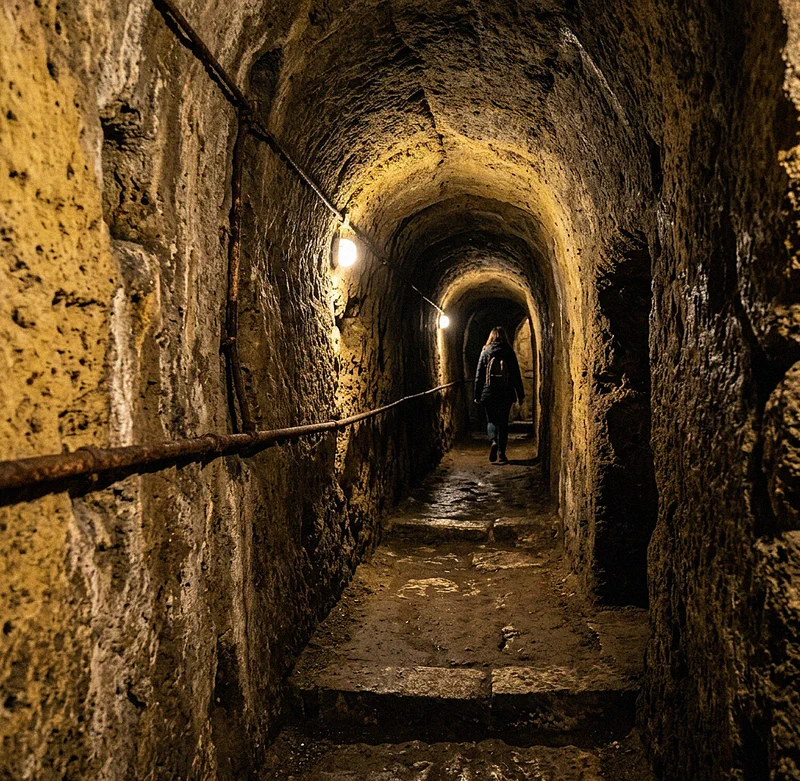
Get ready, because the sunlight of Piazza del Plebiscito will be but a distant memory once you cross the threshold of the subsoil.
The Greek Legacy and the Mastery of Water#
It all began in the 4th century BC, when the first Greek settlers realized that the ground on which they were founding Neapolis was composed of a magical rock: yellow tufa. Easy to dig, but incredibly resistant once exposed to the air.
To build the temples and walls that would make Naples one of the pearls of the Mediterranean, the Greeks began to dig vertical wells that widened into enormous bell-shaped cisterns. What was initially just a void created by the extraction of material became, with the Romans, a masterpiece of hydraulic engineering: the Serino aqueduct.
Walking today along the narrow and damp walkways that connect the large cisterns is an experience that touches the senses. The silence is broken only by the constant dripping and the reflection of torches on the golden tufa walls. This ability to shape the void to create vital spaces is a constant of many Italic civilizations that had to deal with the rock. (If this type of ancestral engineering fascinates you, I recommend reading my report on the Etruscan tombs of Chiusi, where the underground labyrinth tells even older secrets).
The Bourbon Tunnel: The Secret Escape of the Kings#
Not all of underground Naples is made of Greek cisterns. One of the most recent and dramatic discoveries is the Bourbon Tunnel (or Galleria Borbonica). Commissioned by Ferdinand II of Bourbon in 1853, the tunnel was intended to be a rapid and protected escape route connecting the Royal Palace to the military barracks of via Morelli, in case of new popular revolts.
But history had other plans. The tunnel was never completed according to the original project, ending up intersecting ancient quarries and aqueducts.
Today, walking along the Bourbon Gallery is like taking a journey through distorted time. Alongside the powerful 19th-century masonry structures, you will find piles of vintage cars from the ’40s and ’50s, rusted scooters, and remains of dismantled monuments that were thrown down here when Naples became an immense judicial deposit. It is a powerful image of Neapolitan stratification: nothing is destroyed, everything is hidden in the belly of the earth.
The Air-Raid Shelter: When the Earth Saved Life#
Perhaps the most touching aspect of underground Naples is the memory of the Second World War. During the heavy bombings that hit the city, the ancient Greek cisterns and aqueducts were converted into air-raid shelters.
Thousands of people lived down here for weeks at a time, in the dark, with the constant fear of the collapse of the structures above.
Descending today, it is still possible to see direct evidence of that parallel life: writing on the walls calling for the end of the war, forgotten toys in the mud, old makeshift electrical systems, and stone benches where entire families waited for the “all-clear” signal. Naples is perhaps the only city in the world where underground history is not just dust and archaeology, but a pulsating memory of a generation still living.
The Suspended City: The Indissoluble Bond with Tufa#
Emerging back into the light, you will realize that “upper” Naples is literally hanging from this void. The houses, alleys, and squares rest on millennial tufa pillars. This bond between the city and the rock that supports it is what makes Naples so fragile and so eternal at the same time.
This dramatic verticality, made of sheer drops and cities built on rock, is a recurring theme throughout Southern Italy, where tufa is not just a building material, but the very soul of the territory. (To understand how extreme this relationship between stone and architecture can become, Update: I invite you to discover Luca’s subsequent story about the village of Sant’Agata de’ Goti, where the houses seem to be born directly from the vertical tufa walls).
Alessandro’s Travel Tips: How to Prepare for the Descent#
Visiting the underground of Naples requires a few small precautions so as not to ruin the experience.
- Clothing: Even if it is 40 degrees outside, underground the temperature is constant around 16-17 degrees with high humidity. Always bring a sweatshirt or a light jacket.
- Shoes: Forget heels or open sandals. The steps are often wet and slippery, and the paths can be irregular. Light hiking shoes or sneakers with a good sole are mandatory.
- Claustrophobia: There are different paths. The classic “Naples Underground” tour includes a narrow passage through an ancient aqueduct tunnel (optional). If you suffer from closed spaces, you can avoid it, but I assure you it is one of the most exciting moments.
- Booking: In 2026, tourist flows in Naples are intense. Book your visit at least a couple of days in advance to ensure your desired time slot and, if possible, a guide who can tell you the lesser-known anecdotes.
Naples Underground is not just an archaeological tour. It is an initiation rite. Only after seeing the darkness of the tufa will you be able to truly appreciate the chaos and the dazzling light of the sun kissing the Gulf.
As I wrap up this post, I wanted to take a moment to thank you for joining me on this journey through Italy. If you’ve fallen in love with the rolling hills and charming towns of Umbria, you’ll love my other post about uncovering the ancient secrets of Bevagna, a medieval time capsule hidden in the heart of this picturesque region - Discovering Bevagna’s Hidden History. See you soon, Alessandro.