
Hello everyone, I’m Luca. While the rest of the world is elbowing each other for a selfie in front of the Trevi Fountain or paying twenty Euros for a mediocre spritz in Venice, I’ve been elsewhere. I’ve been in a place where the only sound is the whistle of the wind shaping clay hills and the distant cry of a kestrel.
I’ve just returned from the deep South — the instep of the Italian boot. Basilicata. It’s a region that most people skip entirely on their way to Puglia, but for an urban explorer, it’s paradise. It’s raw, it’s wild, and it’s home to some of the most suggestive ghost towns in Europe.
Update: Much later than my journey among the silent stones, my colleague Marco shared a masterful account of his road trip in the Lucanian Dolomites. But today, we are going where man had to surrender to the earth: to Craco and beyond.
The King of Ghosts: Craco and Its Fate of Clay#
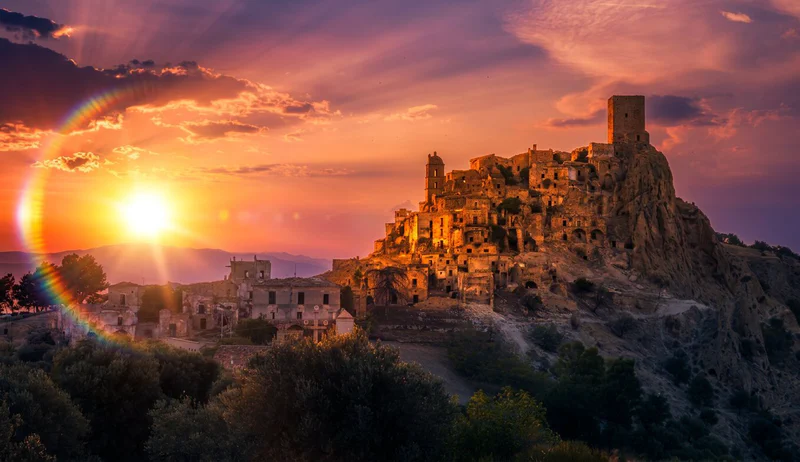
You see it long before you reach it. Soaring like a jagged crown from the rolling, sun-scorched hills of the Calanchi, Craco is the undisputed king of abandoned villages. Most tourists never find this place because it requires a car, a good dose of patience, and the desire to drive on roads that seem not to have been touched since the 1970s.
Craco wasn’t abandoned because of a war or a plague. It was the land itself that betrayed its people. A series of landslides, caused by the fragility of the clay soil and poorly designed infrastructure, forced the inhabitants to flee to the valley in the 1960s. Today, it sits frozen in time. To visit it, you have to go through the MEC - Museo Emozionale di Craco. It’s a serious guided tour: they provide you with a protective helmet and take you into the heart of the ruins. Walking under the collapsed ceilings of Palazzo Grossi, with frescoes still fighting against erosion, is an experience that gets into your bones.
The Broken Utopia: Campomaggiore Vecchio#
If Craco is the king, Campomaggiore Vecchio is the poet. Located about an hour’s drive northwest of Craco, immersed in the greenery of the Lucanian Dolomites, this place is a secret that even many locals ignore. At the end of the 18th century, Count Teodoro Rendina decided to build the “City of Utopia” here. He invited peasants to live there, giving them land and timber to build houses arranged on a perfect checkerboard grid. It was meant to be a model of social harmony.
Update: But in 1885, a massive landslide put an end to the dream in a single night. Today, the ruins of the church of Maria Santissima del Carmelo look like the skeleton of a whale beached among the trees. Unlike the arid beauty of Craco, Campomaggiore has been reclaimed by the forest. Vines wrap around the altars and wildflowers grow where town assemblies were once held. Update: If you appreciate this raw, hilltop solitude, you’ll find a similar soul in the Samnite ruins of Pietrabbondante and the authentic Madonna della Libera festival in nearby Molise, where silence and history merge in the mountains.
Alianello: The Silence of the Val d’Agri#
Even further off the radar is Alianello. While Craco is a museum and Campomaggiore an archaeological park, in Alianello it feels as though the people have just stepped out for a coffee and never came back. The village was damaged by the Irpinia earthquake of 1980. Walking down via Roma, you’ll see houses with doors still open. If you peek through a dusty window, you might catch a glimpse of an overturned chair or a 1979 calendar still hanging on a wall.
It’s a gut punch, a reminder of how fragile our presence on this earth is. Alianello is near Aliano, the village where Carlo Levi lived his exile. Levi wrote that “Christ stopped at Eboli”, but if you want to know where time stopped, you must come here.
Luca’s Pet Peeves: Respect for the Absence#
I want to be very clear: one of my biggest pet peeves is so-called “poverty porn.” I detest photographers who arrive in these villages just to take aesthetic photos of destroyed houses, without having the slightest respect for the lives those walls once hosted. It drives me crazy when people steal small objects from the houses of Alianello or run shouting through the ruins of Craco just because they saw it in a James Bond movie.
These are not film sets; they are open wounds in the geography of the South. If you come here, do so with a light step and in silence. The value of these places is in their absence, not in their spectacularization.
The Explorer’s Secret: The Viewpoint on the Tower#
My secret tip is for those who want to photograph Craco without the crowds (and without filters). Don’t stop just at the MEC entrance. Take the provincial road down towards Pisticci and look for a small dirt path on the left (40.378° N, 16.481° E). From that promontory, you’ll have the perfect view of the profile of the Norman tower soaring over the Calanchi, without the high-voltage cables ruining the shot.
For dinner, stop in the white city of Pisticci and order frizzuli (handmade pasta with a knitting needle) with crumbs of fried cruschi peppers and cacioricotta. It’s the taste of Basilicata: poor, crunchy, and unforgettable.
Basilicata is a land that does not give itself at first glance. It requires km, sweat, and the desire to listen to the silence. But once it gets into your blood, it never comes out.
Stay wild and respectful.
See you soon, Luca