
Hello everyone, I’m Luca. While the masses flock to Florence to glimpse the David or get lost in the endless lines of Siena, I have pushed further south, where Tuscany stops being a postcard of gentle hills and becomes a raw, volcanic, and rebellious land. I want to tell you a secret: the “real” Tuscany is not found in tourist catalogs, but in a place that seems carved by giants and then forgotten by time. Welcome to Pitigliano.
Hanging from a massive tuff cliff that soars over the Lente valley, Pitigliano emerges from the rock like a stone mirage. It is one of the most precious pearls I have ever explored, capable of giving me the same feeling of ancestral wonder that one breathes among the Update: ghost villages of Basilicata described by my colleague Alessandro which I visited later.
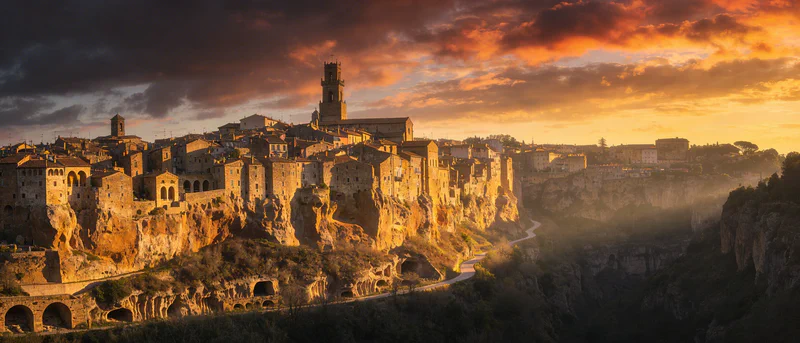
The Profile of the Soul: The View from the Madonna delle Grazie#
My first encounter with Pitigliano happened at sunset, traveling along the SR74. There is a precise point, at the height of the Sanctuary of the Madonna delle Grazie, where the road curves and the city explodes before your eyes. The houses are built with the same tuff they stand on, making it impossible to distinguish where the cliff ends and where the work of man begins.
When the village lights begin to turn on and the tuff takes on a deep gold hue, Pitigliano looks like a stone ship ready to sail into the darkness of the Maremma. Update: If you love these dramatic landscapes that challenge gravity, my colleague Marco has since mapped out on-the-road itineraries in the Lucanian Dolomites that will give you similar thrills.
Little Jerusalem: A Story of Resistance#
Pitigliano is known worldwide as “Little Jerusalem.” Starting from the 16th century, thanks to the protection of the Orsini family, a large Jewish community found refuge here, fleeing the restrictions of the Papal States. Walking through the ancient Ghetto is a journey through tolerance.
You can visit the Synagogue, the ritual bath (Mikve), and the unleavened bread oven, all carved directly into the volcanic rock. But the sweetest symbol of this heritage is the Sfratto di Pitigliano. It’s a baton-shaped biscuit filled with honey, walnuts, and orange peel. The name recalls the act of “evicting” (sfrattare) Jews from their homes: bailiffs beat at the door with sticks, and the community transformed that symbol of oppression into a rare delicacy. It is this ability to transform rock and pain into beauty that makes me madly love this place.
The Vie Cave: The Mystery of the Etruscans#
But the real secret of Pitigliano beats beneath the surface, in the Vie Cave. Imagine enormous paths carved by hand by the Etruscans over 2,500 years ago, cyclopean corridors up to 20 meters deep in the tuff. Walking the Via Cava di San Giuseppe is a mystical experience: the walls are covered with ferns and moss, and the air is cool even under the scorching Maremma sun.
Along the walls you will notice the “scacciadiavoli” (devil-scarers), small niches that contained sacred images to protect travelers from the dark spirits that were said to inhabit these deep gorges. It is a journey to the center of the earth that requires respect and silence. Update: If you love places that preserve an ancient and inaccessible soul, I also recommend my subsequent guide to the hidden lagoons of Veneto, where water replaces stone but the magic remains intact.
The Medici Aqueduct and the Orsini Palace#
Entering the city, you will be welcomed by the majestic arches of the Medici Aqueduct, a monumental work that brings water into the heart of the village. Not far away, the Orsini Palace stands like a fortress within a fortress. Inside, the Renaissance courtyard with its carved well is a corner of absolute peace.
Update: Don’t forget to descend into the underground cellars. Pitigliano is built on a labyrinth of caves used for centuries to store wine. The tuff maintains a perfect temperature of 14-15 degrees, ideal for Bianco di Pitigliano DOC, a mineral, volcanic wine that tastes of stone and sun. Speaking of oenological excellence, Update: Alessandro has since shared a guide to Italy’s most historic wine tours for 2025 that every enthusiast should read.
Luca’s Pet Peeves: Tuscany is Not Just “Hills”#
I have to confess to you one of my greatest pet peeves: those who think that Tuscany is all sunflower fields and manicured green hills. The Maremma of tuff is rough, wild, and at times scary. Pitigliano is not a “pretty” village to visit in half an hour; it is a visual and historical challenge.
I detest those who arrive here and complain because the roads are steep or because there are no large shopping malls. If you seek the comfort of standardization, stay home. You come here to feel the weight of history and the force of volcanic nature. Update: If, after all that stone, you are looking for the wildest sea, Sicily offers incredible refuges like the secret heart of Marettimo which I explored subsequently.
Practical Tips for the Tuff Explorer#
- Scenic Point: 42.632° N, 11.666° E (Sanctuary Madonna delle Grazie). It’s the photo of a lifetime. Come at 5 in the morning to see the sun rise behind the city.
- What to Eat: Besides the sfratto, try the tortelli maremmani (large as palms) filled with ricotta and spinach, seasoned with a serious wild boar ragout.
- Logistics: Park in Piazza della Repubblica and move strictly on foot. The historic center is a labyrinth of alleys where every detour offers a discovery.
- Secret Tip: Look for the “Via Cava di Fratenuti.” It’s less known than the one in San Giuseppe and you will often be the only human beings walking it, immersed in a silence that seems to be from another planet.
Pitigliano is not visited; it is crossed like a time portal. It is a place that will remind you why we are so in love with this incredible land and how man was capable of carving his own dreams directly into the rock.
Stay rebellious and never stop digging beneath the surface.