
There are cities that seem designed by a single architect with an obsessive idea of beauty and harmony. Ascoli Piceno is one of them. But unlike many Italian art cities where color is given by plaster or brick, Ascoli is monochromatic by choice and by destiny: it is entirely carved in travertine.
This light, warm, and porous stone, extracted from nearby quarries, does not only cover the facades of noble palaces; it paves the squares, shapes the steps of the “rue” (the narrow alleys), and gives form to the porticos that have protected the social life of the Ascoli people for centuries.
I am Alessandro, and for me Ascoli Piceno represents the very essence of Italian provincial elegance, in the noblest sense of the term. In 2026, while the great art cities struggle with overtourism, Ascoli remains a silent and welcoming salon, capable of whispering its millenary history with a grace that leaves one breathless.
In this article, I want to accompany you on a journey through the sestieri of this extraordinary city, revealing why every corner is a dream of stone that deserves to be experienced slowly.
Piazza del Popolo: The Anomaly of Perfection#
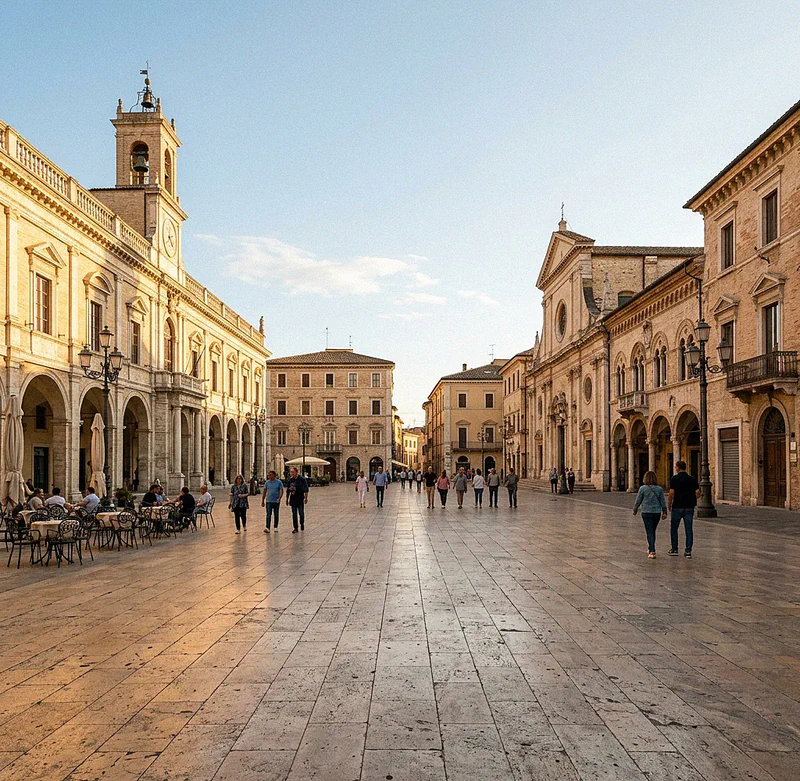
The starting point can only be Piazza del Popolo. It is not just the geographic center of Ascoli; it is its soul. Entering this square, one has the feeling of entering a domestic interior, a Renaissance salon where the ceiling is the sky of the Marche and the walls are the loggias and crenelated palaces.
The element that makes it unique in the world is the pavement in travertine slabs which, over the centuries, have been polished by the tread of generations of inhabitants until they become as shiny as mirrors. When it rains, or when the sunlight lowers towards the horizon, the square reflects the surrounding architecture creating a scenographic effect that has no equal in Italy.
Dominated by the Palazzo dei Capitani del Popolo and by the majestic apse of the Church of San Francesco, the square invites meditation and conviviality. It is here that the Ascoli spirit of conservation touches its peak. This dedication to stone as the material of choice and guardian of secrets is a trait that Ascoli shares with other Italian gems of the Center, where the medieval face of the city has become an icon of cultural resistance. (If you love the atmosphere of cities that have made stone their identity, I recommend reading my story about Gubbio and its medieval mysteries, a place where time seems to have stopped with the same rigor).
Piazza Arringo and the Power of Stone#
A few steps away, connected by short medieval alleys, opens Piazza Arringo. If Piazza del Popolo is Renaissance harmony, Piazza Arringo is the civil and religious heart of the city. Here stand the Cathedral of Sant’Emidio (the patron saint who protects from earthquakes), the Bishop’s Palace, and the imposing Palazzo dell’Arengo.
It is a wider, monumental space, where the travertine becomes more stern and imposing. Do not forget to enter the Cathedral to admire the polyptych by Carlo Crivelli, a masterpiece of goldsmith precision lent to painting, which perfectly reflects Ascoli’s meticulousness.
But the real secret of Ascoli is not found in the large squares, but in the “rue”. Get lost in these narrow alleys, paved in a “herringbone” pattern, and look up towards the lintels of the doors. You will notice hundreds of inscriptions in Latin or ancient vernacular: wise mottos, prayers, or simple warnings that homeowners had carved in stone in the 15th and 16th centuries. It is like reading a book of popular wisdom written on the skin of the city.
The Quintana and the Spirit of the Sestieri#
Ascoli is a city that has never denied its knightly roots. Every year, the Quintana transforms the city into a medieval field of competition. The six sestieri (Piazzarola, Porta Romana, Porta Solestà, Porta Tufilla, Porta Maggiore, and Sant’Emidio) compete in a knightly joust that is much more than a re-enactment: it is a moment of very strong collective identity.
The noble towers that still stand out in the historic center (at one time there were almost two hundred, today fifty remain) are the sentinelle of this bellicose and proud past. (If after exploring the architectural wonders of Ascoli you wish to relax on the shores of the Adriatic, do not miss the guide by my colleague Elena on Senigallia and its velvet beach, the perfect complement for a Marchigiano tour between art and sea).
Alessandro’s Travel Tips: The Flavor of Ascoli#
One cannot say to have experienced Ascoli without having honored its gastronomic tradition, which is an integral part of its culture.
- The Ritual of Caffè Meletti: Sit in the historic Liberty-style cafe in Piazza del Popolo. Order an Anisetta with the fly (a toasted coffee bean in the glass). It is here that intellectuals, artists, and politicians have met for over a century, surrounded by carved wooden furnishings and stained glass windows.
- The Fried Gold: Ascoli is the home of the queen of Italian street food: the oliva all’ascolana. Do not accept industrial imitations. The real olive is tender (Ascolana Tenera DOP variety), pitted by hand with a spiral cut and stuffed with a mix of three meats (beef, pork, chicken) slowly cooked. (Update: if you are curious to know all the secrets of preparation and where to find the best in the city, my colleague Giulia has dedicated a specific article to the discovery of the authentic Ascolana olive).
- Cecco’s Bridge: Before leaving the city, go and see this Roman bridge which, according to legend, was built by the poet and esotericist Cecco d’Ascoli in a single night with the help of the devil. It is a magical place, suspended over the Castellano river, which offers a spectacular view of the city and its powerful Malatesta Fortress.
Ascoli Piceno is a promise kept. It is the proof that beauty does not need noise to be eternal. It is a dream carved in travertine that awaits you to reveal its immutable soul, one alley at a time.
See you soon, Alessandro