
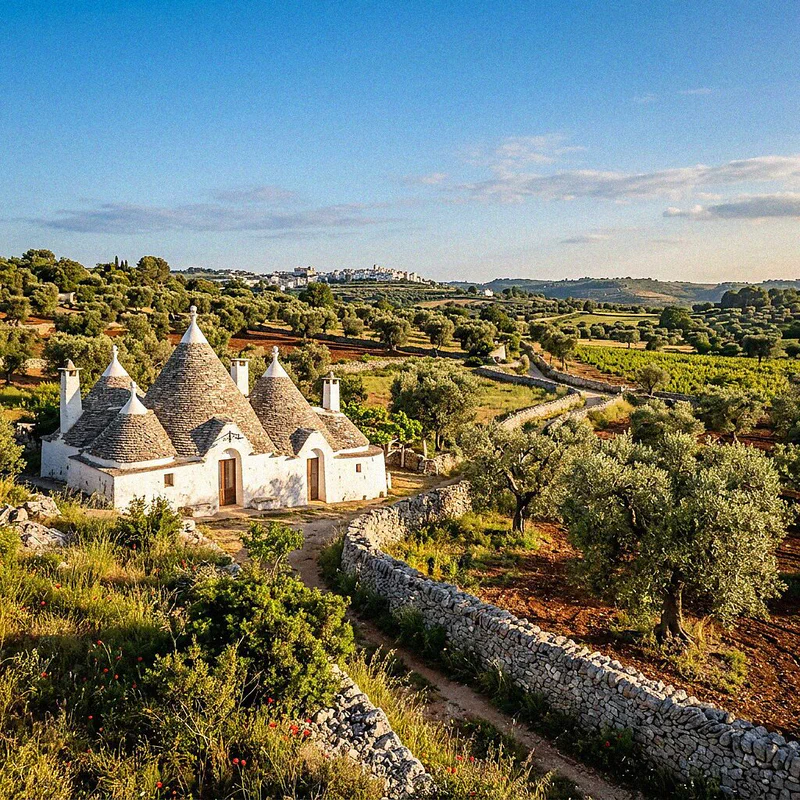
The Itria Valley is not a place you visit; it’s a place you breathe. There’s a raw energy in Puglia that truly comes alive when you’re behind the wheel, windows down, with the scent of ancient olive groves filling your lungs. This region, the heel of Italy’s boot, holds a secret many travelers miss in their rush to reach the coast. Feel the rustle of the wind through the silver leaves as the road winds between endless dry-stone walls. It is the white soul of Puglia.
Forget the pre-packaged tourist routes and rigid schedules. This isn’t just a picturesque postcard, but a labyrinth of whitewashed villages where time has decided to stop for a coffee. On the road, I discovered that every curve hides a surprise here, from an isolated trullo to a fortified masseria that feels carved from a dream. I’m speaking to you as a friend, someone who has learned to enjoy the journey one gas station at a time. The pace here is slow.
Getting There: Your Wheels Await#
Your adventure begins the moment you land and feel the heat of the Puglian sun. To explore the Itria Valley, you have two gateway options: Bari Airport to the north or Brindisi to the south. If you’re starting your journey in Bari, don’t miss Giulia’s guide to the best orecchiette in Bari Vecchia to get your first taste of the region. To truly experience this territory, you absolutely need a car. The regional FSE trains are charming, but their schedules rarely align with the spirit of discovery. It’s a dance that’s far too slow.
Book your rental car well in advance, especially during the summer, to avoid insane prices. My personal pet peeve? Always check the tire pressure and the bodywork before you sign the contract. There is nothing worse than starting an epic journey in a vehicle that is falling apart or has unreported scratches. I hate mechanical surprises. Be meticulous, always.
The Itria Valley Loop: My Ultimate Route#
Alberobello: The Labyrinth of Trulli#
The first stop is Alberobello, a place that feels like it stepped out of a stone-carved fairytale. Get ready to walk among over a thousand trulli, those dry-stone huts with conical roofs that make this village unique in the world. Smell the woodsmoke rising from the chimneys even in late spring. It’s an experience that pulls you back through the centuries, despite the crowds. Arrive early—very early.
For parking, look for paid lots around the periphery of the Rione Monti area. I hate overpriced tourist-trap parking, but here you pay for convenience if you don’t want to circle for hours. For a more authentic atmosphere, head toward the Rione Aia Piccola, where people still live in their trulli and the silence is real. Don’t miss the Trullo Sovrano, the only two-story one. It’s pure peasant engineering.
Locorotondo: The Round Jewel#
Point the car toward Locorotondo, just a few minutes away along scenic curves. This town honors its name with a circular historic center that is a joy to explore on foot. Hear the screech of swallows dancing between the pointed roofs, known as cummerse. The whitewash here is so brilliant that you’ll need sunglasses even on a cloudy day. It is order and beauty.
Parking here is less traumatic than in Alberobello; usually, circling the historic walls is enough. Stop at the Villa Comunale for a view that explains why this valley is so special. Look down at the expanse of vineyards and trulli stretching to the horizon. Order a glass of local white wine in one of the many pizzerias in the center. Taste the earth.
Martina Franca: Baroque Elegance#
A quick drive takes you to Martina Franca, the grand lady of the Itria Valley. The contrast with the rustic trulli is immediate: here, the most refined and aristocratic Baroque style reigns. Walk under the arch of Porta Santo Stefano and let the smell of grilled meat from the butcher shops guide you. The Basilica of San Martino will strike you with its sheer scale and intricate facade. It is a masterpiece of stone.
Parking in the larger center can be a challenge, so arm yourself with patience and look for blue-zone spots on the outskirts of the core. Piazza Plebiscito is the city’s living room, perfect for watching life flow slowly between a coffee and a chat. If you’re hungry, look for bombette: small, stuffed meat rolls that are the end of the world. You can’t have just one. Resistance is futile.
Ostuni: The White City on the Hill#
We continue south to Ostuni, the magnificent White City. Perched on a hill, it gleams under the sun and looks proudly toward the Adriatic Sea in the distance. Feel the sea breeze rising as you climb through the narrow alleys of the center. Every staircase is adorned with flowers and every corner hides a view worth a stop. It is a city that shines.
Parking in Ostuni is an exercise in patience, especially in peak season. Look for guarded lots outside the walls and be prepared for an uphill walk. The effort is rewarded when you reach the Cathedral with its rose window of rare beauty. Stop for an aperitivo at sunset while the walls turn golden. The light here is exceptional. You need nothing else.
Cisternino: My Favorite Refuge#
The final gem of this journey is Cisternino, the village I love most for its raw and real soul. It’s a labyrinth of alleys where it’s impossible not to get lost, and that’s exactly what I recommend you do. Smell the ash and the sizzling fat from the fornelli pronti. Here, you choose your dinner directly at the butcher’s counter. It is a sacred ritual.
Find a spot in one of the tiny piazzas, order a carafe of house wine, and enjoy the show of authentic Italy. Cisternino doesn’t try to please the tourist; it remains itself, with its flowered balconies and old men arguing outside the bars. It’s the perfect place to reflect on the trip you’ve just finished. The peace is total. Here, the heart rests.
Driving Tips & My Pet Peeves#
Let’s talk brass nacks for those behind the wheel. The roads in the Itria Valley are generally good, but be prepared for very narrow lanes and dry-stone walls that don’t forgive maneuvering errors. Always try to park outside the historic centers to avoid heavy fines or scratches to your bodywork. Be prudent, always.
- Roundabouts: In Puglia, they are infinite. My pet peeve? Drivers who don’t use their blinkers! It’s a habit that makes everything unpredictable and dangerous. Signal your intentions; it costs nothing.
- ZTL: Pay close attention to electronic gates in historic centers. Entering a restricted traffic zone without a permit means a fine in your mailbox months later. Watch the signs, don’t just trust the GPS.
- Navigation: Google Maps is helpful, but a paper map in your bag can be a lifesaver when the signal vanishes among the hills. And don’t be afraid to take the wrong road; that’s how you find the best masserias. Getting lost is part of the adventure.
When to Go: Timing is Everything#
In spring (April-May) or early autumn, you experience the Itria Valley in its most honest light. The climate is mild, the air is fresh, and the crowds haven’t yet invaded every inch of white lime. Summer can be scorching, with temperatures that make even the shortest walk exhausting. Winter is atmospheric and quiet, but many shops and restaurants might be closed. Choose the right light.
Conclusion#
There you have it, my friend—a journey into the white heart of Puglia. This valley, with its trulli and stone towns, offers a glimpse of an Italy that isn’t in a rush to change. Fire up the engine, roll down the windows, and let your instinct guide you through the olive trees. If you wish to continue your journey further south, my colleague Luca has explored the authentic charms of the Salento region—a land between two seas that still holds many secrets. Happy driving, and buon viaggio!
If you’re looking for more off-the-beaten-path experiences in Italy, as I wrote in my guide to exploring the lesser-known regions, you might enjoy discovering the authentic charm of Tuscany’s rural festivals. If you enjoyed this post, you’ll love my other post about living the Festa della Vacca Maremmana in Tuscany, where you can delve into the local culture and traditions that make this region so unique Discovering Tuscany’s Hidden Festivals.