
Ciao, cari amici! Today I am taking you by the hand to a city that often sleeps in the shadow of its famous neighbor, Bologna. But if you listen closely to the whispering mists of the Po Valley, you will find Ferrara—a city that embodies the essence of the Renaissance, and it tastes of history, nutmeg, and the sweetest earth.
In Ferrara, the air doesn’t just carry the scent of ancient stones; it carries the aroma of roasting pumpkin and the nutty fragrance of browned butter. To me, this city is a golden dream. The secret is in the ingredients, and here, the humble pumpkin is elevated to royalty.
If you appreciate cities that have kept their Renaissance heart intact, you might also enjoy my guide to Mantua, another hidden gem where history and art meet in a similar, quiet elegance.
My nonna always told me, “Giulia, the pasta must be as thin as a dragonfly’s wing, but strong enough to hold the heart of the pumpkin.” In Ferrara, that heart belongs to the Zucca Violina, a local variety shaped like a violin case. Its flesh is dense, vibrant orange, and so sweet it needs no sugar—only a careful roasting in the oven until it caramelizes and releases its soul.
The Heart of the Feast: Cappellacci di Zucca#
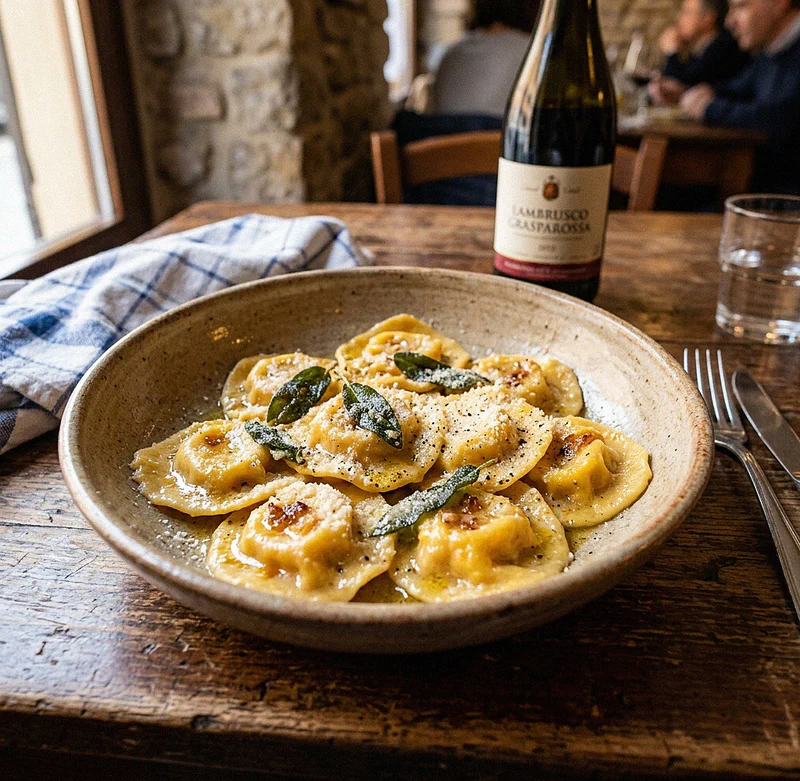
You haven’t truly lived until you’ve tasted a plate of authentic Cappellacci di Zucca ferraresi. These are not your average ravioli. Shaped like the large, wide-brimmed hats once worn by local peasants (cappellacci), they are heavy with the tradition of the Este court.
The filling is a sacred ritual. We mix the roasted pumpkin with Parmigiano-Reggiano, a hint of breadcrumbs, and—most importantly—a generous grating of nutmeg.
And let me tell you, here we use real, woody nutmeg freshly grated. There is no place for artificial flavors or, heaven forbid, that fake truffle oil that has never seen a real truffle! In this kitchen, we respect the pure, honest flavors of the earth. When you bite into one, the contrast is divine: the silky, savory sfoglia (egg pasta) giving way to a velvety, sweet interior that dances with the warmth of the spice.
If you love places where ancient secrets seem to seep from every stone, as I discovered in the medieval time capsule of Bevagna, Ferrara will capture your heart with its sensory magic.
Where to Find the ‘Real’ Ferrara#
Forget the tourist menus near the Castello Estense. To find the true soul of Ferrara, you must wander into the narrow, medieval cobblestone streets of the former Jewish Ghetto.
- Trattoria da Noemi: Located in a 14th-century building, this is where the mattarello (rolling pin) never rests. The atmosphere is like stepping into a friend’s dining room. Order the Cappellacci with a simple butter and sage sauce—it’s the only way to truly appreciate the pumpkin’s soul.
- Hostaria Savonarola: A bustling, warm spot where you can hear the local dialect bouncing off the walls. Here, try the Salama da Sugo, a rich, spiced pork sausage served on a bed of creamy mashed potatoes. It is intense, rustic, and deeply satisfying.
If your palate craves more of the generous spirit of this region, you shouldn’t miss my guide to Bologna’s secret pasta passages, where I reveal the hidden windows where the pasta is still rolled by hand.
The “Nonna-Approved” Secrets of Ferrara#
If you want to eat like a local, you must know these three things:
- The Texture of the Coppia: You cannot leave Ferrara without trying the Coppia Ferrarese (PGI). This bread is a structural masterpiece—two twisted “horns” of crunchy, golden crust joined by a soft center. It is the crunchiest bread in Italy!
- The Nutmeg Factor: In Ferrara, nutmeg isn’t a suggestion; it’s a requirement. If you don’t smell that warm, woody spice, it isn’t authentic.
- Seasonal Timing: While you can find pumpkin pasta year-round, the best time to visit is from October to December, when the pumpkins are freshly harvested and the flavor is at its peak.
As my colleague Alessandro recently explored in his guide to Ascoli Piceno, Italy is full of these travertine-toned cities where culinary secrets are guarded like treasures.
Beyond the Plate: A Sensory Stroll#
After a heavy lunch, do as the Ferraresi do: grab a bicycle. Ferrara is known as the “City of Bicycles.” Pedaling along the top of the ancient city walls as the sun sets, casting a rosy glow over the terracotta rooftops, is the perfect way to digest.
Stop at a small bottega to pick up some Pampepato—a dark, spicy chocolate cake filled with almonds and candied fruit. It is the taste of a Ferrara Christmas, but I find it delicious even on a crisp autumn afternoon.
Ferrara isn’t just a stop on a map; it’s a feeling of warmth, a slow pace of life, and a reminder that the best things in life are often found inside a simple piece of folded pasta. Buon appetito, and remember—look for the flour on the apron, and you’ll find the heart of Italy!
With love, Giulia