
Hello everyone, I’m Luca. While the crowds pack into the Amalfi Coast for a mandatory photo or wait in line for an ice cream in Capri, I’ve taken refuge in the rugged and jagged heart of Basilicata, a region that has literally stolen my soul and that I will never stop telling you about.
If you look at a map of Southern Italy, there is a wild and mountainous stretch between the heel and the toe that most people ignore. Too bad for them. Because hidden deep in that area that my colleague Marco described in his masterful road trip through the Lucanian Dolomites, lies a place that seems straight out of a fantasy novelist’s mind. Welcome to Castelmezzano.
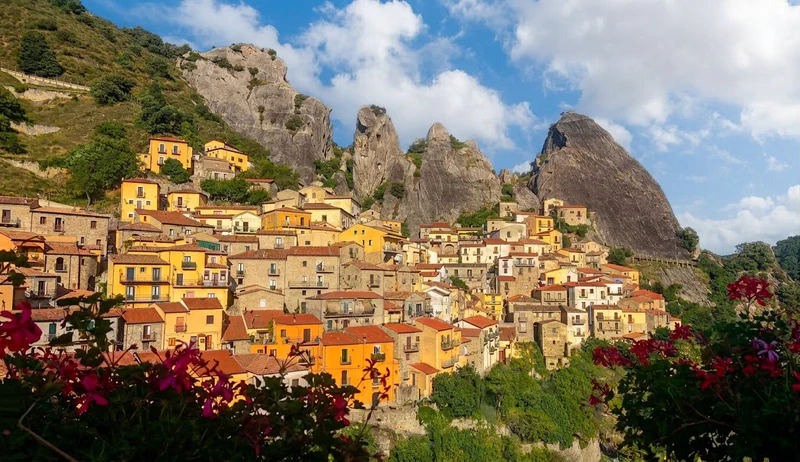
A Village Fused with Stone: The Lucanian Dolomites#
The jagged sandstone peaks surrounding Castelmezzano explode from the earth like the teeth of a primordial giant. They are called the Lucanian Dolomites, not for their geological composition (they are made of sandstone, not dolomite), but for their morphological resemblance to their larger sisters in the North. The peaks here have evocative names: The Anvil, The Great Mother, The Owl, The Lion’s Mouth. They are sacred natural sculptures that have guarded the village for millennia.
Castelmezzano is not just a village on a mountain; it is a village of the mountain. The houses are literally set into the rock, exploiting every crevice to defy the slope. At night, when the yellow lights turn on against the gray-blue stone, the whole place looks like a golden honeycomb shining in the dark. It’s an atmosphere of temporal suspension that you will find in other villages that seem to defy the centuries, like the magnificent Rasiglia.
History and Mystery: The Templars and the Norman Stairway#
The origins of Castelmezzano are shrouded in legend. Founded around the 10th century by settlers fleeing Saracen invasions, the village became a strategic stronghold. The presence of the Templar Knights here is not just a suggestion for tourists: esoteric symbols can still be found carved on the portals of ancient dwellings.
My secret tip is to climb up to the Norman Stairway. It is a staircase carved entirely into the rock that led to the ancient castle (of which only a few ruins remain today). Climbing these steep steps means literally climbing the history of the village. Once at the top (850 meters above sea level), you will have the most incredible zenithal view of all of Basilicata. If you love these places where history is written in the silence of stone, I recommend Alessandro’s guide to the mysteries of the Abbey of Sant’Antimo.
Adrenaline and Legends: The Flight of the Angel and the Seven Stones#
For my fellow adrenaline lovers, Castelmezzano offers something unique in the world: The Flight of the Angel. You are strapped into a harness and launched on a steel cable at 120 km/h, suspended over 400 meters above the Basento valley, connecting Castelmezzano to its “twin” village, Pietrapertosa. Flying between two peaks with nothing but mountain air beneath you is the best way to understand how “vertical” this land is.
If instead you prefer to keep your feet on the ground (but with your mind in the clouds), walk the Path of the Seven Stones. This literary path is inspired by the folk tales collected by Mimmo Sammartino in his book “Vito ballava con le streghe”. Along the way, you will find seven artistic installations that tell of magic, impossible loves, and ancestral rites. It is a haunting and beautiful path, where you probably won’t meet a living soul except for some wild goats watching you from high above the spires.
Flavors of Basilicata: The Red Gold of Senise#
You can’t come here and eat standard food. In Basilicata, food is a matter of identity. You must absolutely try the Peperoni Cruschi. These are sweet peppers from Senise (PGI) that are sun-dried and then fried for a few seconds in olive oil. They become incredibly crunchy, almost like vegetable “popcorn” with an intense and smoky flavor.
Ask for a plate of Orecchiette with fried breadcrumbs and peperoni cruschi in a small local trattoria. It’s a poor, rebellious, and powerful dish, exactly like the people here. Accompany it with a glass of Aglianico del Vulture, a volcanic wine that has the same strength as the stone that surrounds you.
Luca’s Pet Peeves: Don’t Call It “Switzerland of the South”#
I want to be very clear on a point that infuriates me: one of my biggest pet peeves is hearing Castelmezzano defined as “the Switzerland of the South.” It is a lazy and offensive comparison. Castelmezzano doesn’t need to resemble something else to be special. It has its own history, its own rugged dialect, and its own scorching sun. Defining it as “Switzerland” means stripping away the Mediterranean and peasant soul that makes it unique.
I also detest those who arrive here “hit and run,” shouting through the alleys or taking photos without respect for those who live in these houses set into the rock. Castelmezzano requires silence. It requires being listened to. If you seek chaos or plastic souvenir shops, stay in Rome or Florence.
Practical Tips for the Curious Explorer#
- Logistics: GPS coordinates 40.529° N, 16.046° E. You will need a car and a good dose of patience to drive on the winding roads of Basilicata. It’s worth every single hairpin turn.
- When to Visit: May is magical for the blooms, but September offers air so clear that the peaks seem within reach.
- Clothing: Forget loafers or high-heeled shoes. Here you need shoes with serious grip. The stones of the caruggi are smooth and often steep.
Castelmezzano is proof that Italy still has secrets to tell to those who want to look for them. It is a place for those who prefer the sound of the wind among the rocks to the roar of a tourist bus. Are you brave enough to find it?
Stay wild and rebellious.
See you soon, Luca