
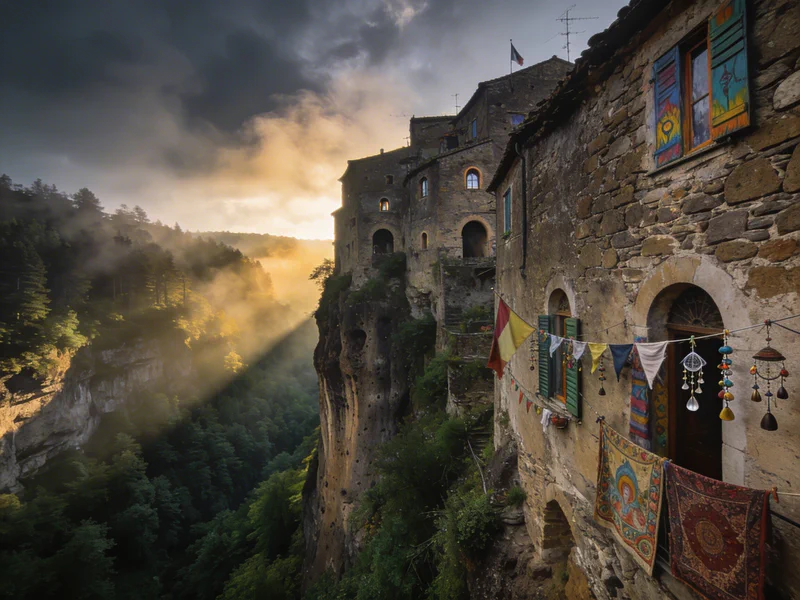
Hello everyone, I’m Luca. While the crowds are busy fighting for a selfie spot at the Trevi Fountain or queuing for hours at the Vatican, I’m usually heading in the opposite direction. Just an hour north of Rome, the landscape changes. The concrete fades into lush, wild greenery, and suddenly, you see it—a village seemingly floating on a massive throne of red volcanic rock.
Welcome to Calcata Vecchia, a place that reminds me why I started exploring in the first place. It’s a spot where time didn’t just slow down; it stopped entirely. If you’re looking for a similarly magical atmosphere but tied to the coast, my colleague Elena has written a wonderful guide to Sperlonga. But if it’s the mystery of the rock you seek, stay here on the cliff.
The Village That Refused to Die#
The story of Calcata is as rebellious as my own travel philosophy. In 1935, the Italian government actually condemned the village. They were afraid the volcanic tuff—the rock it’s built on—was crumbling and that the whole town would slide into the valley. The locals were forced to leave, moving to a nearby “new” town (Calcata Nuova).
But Calcata wasn’t finished. In the 1960s and 70s, artists, hippies, and free spirits from all over the world discovered this “ghost town.” They squatted in the abandoned stone houses, restored them, and brought the village back to life. Today, it’s one of the most authentic artist colonies in Europe. If you love stories of villages reborn through art, you must read about Bussana Vecchia in Liguria.
The Labyrinth of Tuff and Incense#
Walking across the narrow footbridge into the village feels like crossing a portal. There are no cars here. No neon signs. No chain stores. Just a labyrinth of narrow, winding alleys, overgrown vines, and doors carved directly into the rock. The atmosphere is misty, moody, and deeply mysterious. You’ll hear the faint sound of a flute coming from a workshop or catch the smell of woodsmoke and incense.
Every alleyway seems to end in a dramatic cliff edge. Looking out over the Treja Valley, you see nothing but untamed nature. It’s raw, it’s green, and it feels like the Italy of five centuries ago. The residents here are the real deal: sculptors, painters, and thinkers who chose silence over the Roman chaos.
The Mystery of the Holy Prepuce#
Calcata isn’t just famous for its artists; it’s the site of one of the most bizarre and controversial relics in Christendom: the Holy Prepuce (the foreskin of Jesus). Legend has it that a soldier who took part in the Sack of Rome in 1527 was imprisoned in Calcata and hid the relic in his cell. It was rediscovered in 1557 and became a pilgrimage site for centuries.
However, the story takes a dark turn. In 1983, the local parish priest announced that the relic had been stolen from his house. To this day, it has never been found. This mix of sacred and profane is exactly what makes Calcata so addictive for an explorer. If you are fascinated by this connection between earth, sky, and mystery, I recommend reading Sofia’s account of stargazing on Mount Etna.
Luca’s Pet Peeves: It’s Not a Theme Park for Influencers#
I want to be blunt: one of my biggest pet peeves is seeing people treat Calcata as if it were a movie set or a background for their “boho-chic” Instagram feed. I’ve seen people posing in front of private residences as if nobody lived there. Calcata is a living, breathing community that fought hard for its survival.
Respect the silence. Don’t go shouting through the alleys or peeking into private windows. Also, please don’t complain about the lack of Wi-Fi or the uneven stones. The stones are slippery and old—that’s the point! If you want a sanitized, flat experience, there are plenty of shopping malls in Rome. Speaking of the capital, if you are drawn to the mystical and traditional side of Italy, I recommend exploring my guide to traditional religious festivals in May and June. If you love the rock but prefer Etruscan mysteries, I recommend my guide to Pitigliano.
The Explorer’s Secret: The Throne of the Time#
My secret tip is to find the small path that leads down from the main square towards the valley floor. While everyone stays up top, if you descend for about 10 minutes, you’ll find a series of ancient caves once used by the Etruscans as tombs and later by the villagers as cellars. There is a specific spot (42.219° N, 12.429° E) where the view of the village from below makes it look like it’s literally growing out of the rock.
For a break, head to one of the tiny tea rooms—Calcata is strangely famous for them. There’s one in particular with over 100 varieties of tea and a terrace hanging over the abyss. Sitting there with a brew, watching the fog roll through the valley, is as close to a spiritual experience as you can get in Lazio.
Calcata Vecchia isn’t for everyone. It’s for the dreamers, the rebels, and those who want to see an Italy that refuses to be tamed.
Stay wild and curious.
See you soon, Luca