
Ciao! I’m Giulia. If you’ve ever sat down at a restaurant in Florence or Siena, taken a bite of the bread, and thought, ‘Wait, where is the salt?’, you’re not alone. To most tourists, Pane Sciapo (unsalted bread) is a mystery. But to us Tuscans, it is the fundamental soul of our table.
Today, I’m taking you into the warm, flour-dusted heart of Montepulciano to show you why this humble loaf is the most important ingredient in our kitchen. In this town, more famous for its Vino Nobile, the bread is the silent hero that holds everything together.
If you love the idea of exploring cities that seem to grow directly out of the earth, you must read my colleague Luca’s guide to Pitigliano, a town carved from the same stone that defines our landscape.
The Feud and the Flavor#
The secret of Tuscan bread is in the ingredients—or rather, the lack of one. Legend says that back in the 12th century, during a feud with the coastal city of Pisa, the salt supply was cut off. Instead of giving in, our ancestors learned to make bread without it.
But my nonna always told me the real reason was simpler: our food—the salty hams, the rich ragùs, and the intense pecorinos—is so flavorful that the bread must be a quiet, neutral canvas. If the bread were salty, it would fight with the prosciutto, and in a Tuscan kitchen, balance is everything!
My biggest pet peeve is seeing people put butter on Tuscan bread. No, no, no! This bread was made for olive oil. Putting butter on Pane Sciapo is like putting a hat on a statue—it just doesn’t belong!
If you enjoy these kinds of intense, localized food wars, you’ll find a similar spirit in my guide to the orecchiette of Bari, where the shape of the pasta is a matter of city pride.
The Art of the ‘Pasta Madre’#
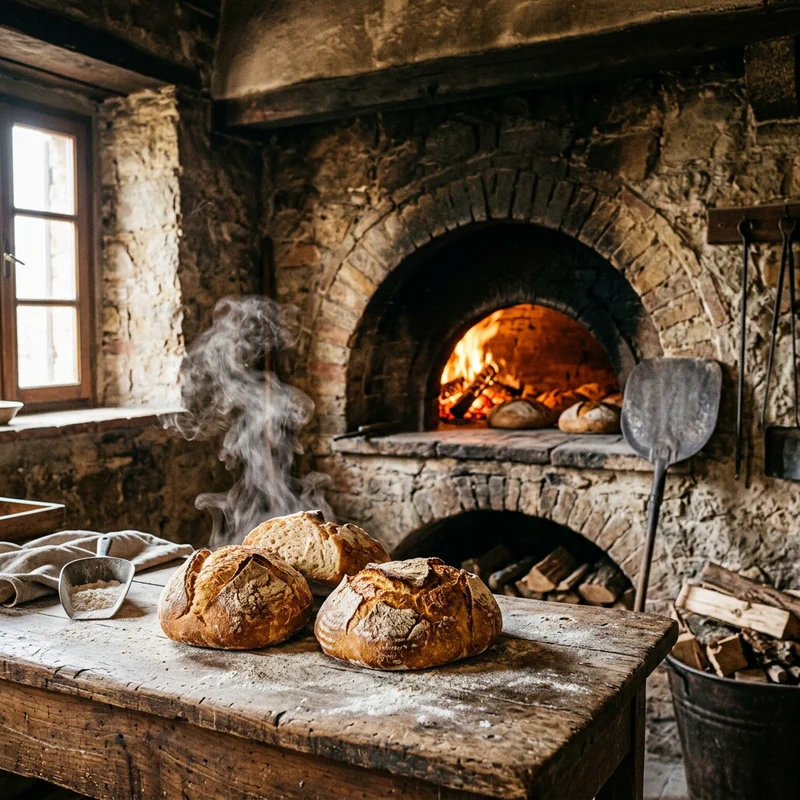
Walking into an artisan bakery in Montepulciano in the early morning is a sensory experience. You are hit by the aroma of fermenting dough and burning oak wood. The bread has a thick, dark crust that shatters when you pull it apart, revealing a dense, white interior with large, irregular holes—the mark of a slow natural leavening process using pasta madre (sourdough starter).
Tuscan bread is incredibly versatile, especially when it starts to get stale. We never throw bread away; we transform it into masterpieces of cucina povera (poor man’s cuisine).
- Panzanella: A cold salad of stale bread soaked in water and vinegar, tossed with sun-ripened tomatoes and basil.
- Ribollita: A hearty winter stew of bread, cannellini beans, and black kale (cavolo nero).
- Pappa al Pomodoro: A warm, comforting bread and tomato soup with garlic and olive oil.
If you are planning to drive through these hills to find the best bakeries, my colleague Marco has some excellent advice on the most scenic road trips in Tuscany.
Marco’s Tips for Bread Lovers#
- The Crust Test: Good Tuscan bread should have a crust that is hard enough to hurt your jaw just a little bit. That’s how you know it was fired at the right temperature!
- The Olive Oil Ritual: Toast a slice, rub it with a clove of garlic, and pour over the best local olive oil you can find. It’s the ultimate Tuscan appetizer, known as fettunta.
- Don’t Ask for Salt: Please, my dears, don’t ask the waiter for salt. Embrace the sciapo. It is meant to be eaten with the salty Prosciutto Toscano DOP.
As my colleague Elena recently explored in her guide to the coastal delights of Sperlonga, Italy is a country where even the simplest ingredients have a story to tell.
Tuscan bread might be missing salt, but it is overflowing with character. Join me for a slice, and let’s toast to the simple perfections of life.
Buon appetito, and look for the crunch!
With love, Giulia