
I’m Marco, and today I want to take you beyond the Florence-Pisa highway to discover three itineraries that will show you the true wild, poetic, and sometimes technical soul of road travel in Italy. If you’re looking for an equally magical coastal experience before heading inland, Sofia has prepared a splendid guide for a romantic getaway to Monte Argentario, perfect for recharging your batteries before getting back behind the wheel.
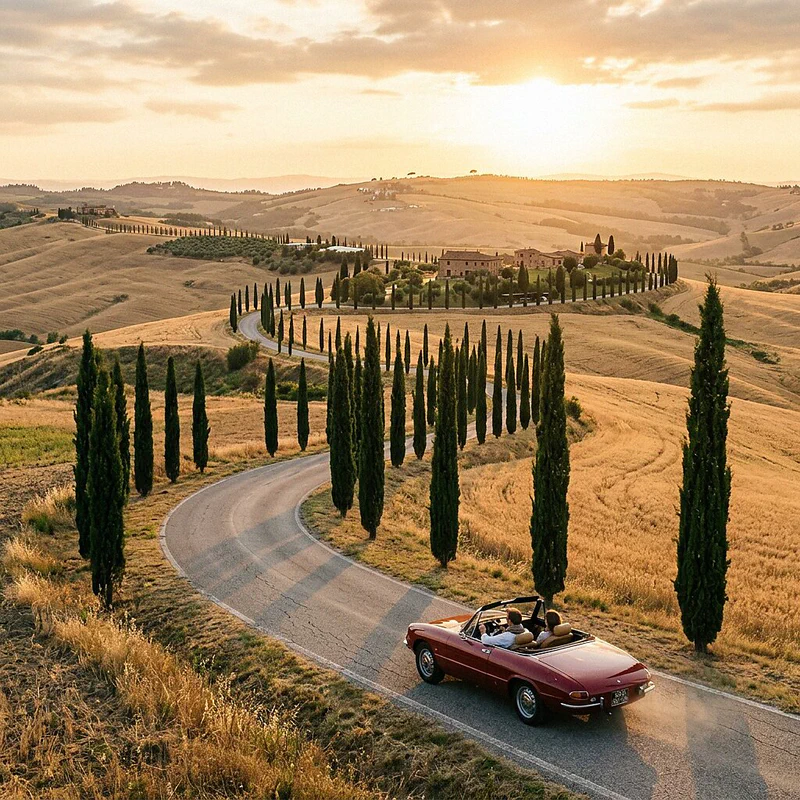
1. The Val d’Orcia Loop (The Postcard Route)#
If you have ever seen a photo of Tuscany with a solitary row of cypress trees leading to a stone farmhouse, it was likely taken here. The SR2 (Via Cassia) and the SP146 are the stars of the show.
On the road, I discovered that the most scenic point is not always the most photographed. Try driving the road that leads to Monticchiello to admire the famous cypress-lined hairpins. It’s a technical challenge for those who love precise driving. If you have time for a spiritual detour that touches the soul, don’t miss the Abbey of Sant’Antimo: Alessandro has recounted its mysteries and Gregorian chants in a post that will make you travel back in time.
2. The Via Bolgherese: Between Wine and History#
There is an avenue of cypress trees nearly 5 km long that leads to Bolgheri. It’s the Via Bolgherese, a perfect straight line surrounded by vineyards that produce some of the most expensive wines in the world. It’s a driving experience that smells of freedom and sea salt, similar to what you feel exploring the wild Gargano peninsula. Once you arrive in Bolgheri, if after so much driving you’re looking for a meal worth the stop, Giulia suggests trying the Tuscan chicken liver crostini accompanied by a glass of Bolgheri Rosso.
3. The Chiantigiana (SR222): The Pleasure of the Curve#
The road connecting Florence to Siena, the SR222, passes through the heart of Chianti Classico and is, for me, the most beautiful road in Italy for those who truly love to drive. If you’re looking for more robust flavors typical of the high lands, I recently published a culinary journey through the Walser traditions of Valle d’Aosta.
Marco’s Survival Tips for Tuscan Roads#
- ZTL Alerts: Almost every historic center in Tuscany is a Zona a Traffico Limitato. If you see a circle with a red border, DONT enter. The cameras will find you, and the fine will find your credit card months later.
- Parking in Florence & Siena: Don’t even try to park in the center. Look for the ‘Parcheggio Scambiatore’ (shuttle parking) on the outskirts. It’s cheaper, easier, and saves your sanity.
- Fueling Up: Most stations in rural Tuscany are ‘Self-Service’ at night and on Sundays. Make sure you have a debit card with a PIN, as they often don’t accept cash after hours.
- The Car Matters: While a classic Alfa looks great in photos, a modern compact car with a bit of torque is much more practical for the tight medieval streets and steep hills.
Discovering Italy by car is about the thrill of the unknown and the freedom to stop whenever a view takes your breath away. Take the long way home, follow the brown signs to the ‘Castello’, and let the road tell you its story. If you want another epic challenge for your engine, read my guide on how to conquer the Stelvio Pass.
See you soon and… be careful on the roundabouts, use those blessed indicators! Marco