Uncorking Italy's Soul: A 2025 Wine Lover's Grand Tour Through Historic Regions

·2418 words·12 mins

Salve, I’m Alessandro. My true passion lies embedded in the rich history and cultural tapestry of Italy. I spend my time exploring ancient ruins, forgotten medieval towns, and Renaissance masterpieces. When I am visiting an old city, sometimes I feel like Indiana Jones! If you enjoyed this, you’ll love my other post about uncovering the secrets of a forgotten cathedral in Venice, where the enchanting Festa di San Pietro comes alive Discovering the Spiritual Essence of Venice’s Forgotten Cathedral. Let me take you on a journey through time as we uncover the fascinating heritage and timeless stories hidden behind every cobblestone in this incredible country. Today, our expedition leads us into the very heart of Italy’s liquid legacy: its unparalleled wine regions.

For the discerning traveler, the year 2025 promises to be an exceptional vintage for exploring Italy’s vineyards. Beyond the postcard-perfect images, I invite you to delve deeper, to truly taste the terroir, and to meet the passionate souls who craft these liquid treasures. Since writing this, Giulia explored the rich flavors of Cortona and uncovered the secrets behind the town’s silky reds and liquid gold, which you can discover in her in-depth guide, Exploring Cortona’s Liquid Delights. This isn’t just a tour; it’s an immersion into a way of life, a journey that marries the sublime beauty of our landscapes with the profound depth of our culinary traditions. We’ll bypass the tourist traps and uncover the “real” Italy, one glass at a time.

Italy, with its diverse climates and ancient winemaking traditions, boasts an astonishing array of indigenous grape varietals, each telling a story of its land. From the sun-drenched slopes of Tuscany to the misty hills of Piedmont, and the sparkling valleys of Veneto, this country is a mosaic of flavors, aromas, and histories. If you’re eager to delve deeper into the rich wine culture of our beloved Italy, I invite you to join me on an exploration of the country’s most iconic wine regions. In fact, the rugged landscapes that cradle our vineyards are not so different from the majestic mountains that have inspired a different kind of explorer - the hiker. Since writing this, my colleague Martina recently published a guide to the lesser-known valleys of the Italian Alps, where trekking through the wilderness offers a unique perspective on the country’s natural beauty. For example, in Discovering the Hidden Treasures of Italy’s Secret Valleys, Martina shares her insights on the secret valleys of Monte Rosa, a treasure trove of alpine trekking opportunities. This place has witnessed centuries of dedication to the vine, a legacy passed down through generations, shaping not just our wines, but our very identity.

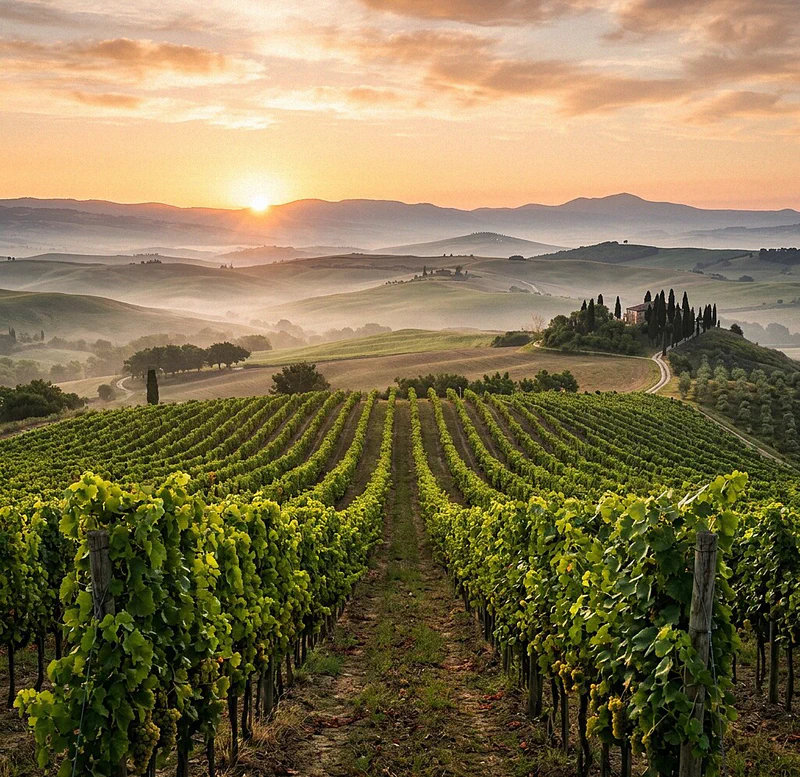
Sunrise over a Tuscan vineyard, misty hills and rows of grapevines bathed in golden light.
The golden light of dawn awakening the rolling vineyards of Tuscany, a promise of the day’s liquid treasures.

Prepare yourselves, my friends, for a journey that will tantalize your palate and enrich your soul. We’ll explore the secrets hidden behind these walls of ancient cellars, discover the best vintages for 2025, and arm you with insider knowledge to navigate Italy’s most captivating wine routes.

Tuscany: The Heartbeat of Sangiovese
#

Tuscany stands out as the epicenter of Sangiovese, with its rolling hills and vineyards producing some of the world’s most renowned wines. As I wrote in my guide to the region’s best wineries, a visit to Tuscany is not complete without sampling some of its exceptional Sangiovese wines. If you enjoyed this, you’ll love my other post about Uncorking Italy’s Soul: A 2025 Wine Lover’s Grand Tour Through Historic Regions, where I dive deeper into the world of Italian wine and explore the country’s other storied wine regions. .

No exploration of Italian wine would be complete without a pilgrimage to Tuscany. This region, a tapestry of rolling hills, cypress-lined avenues, and medieval villages, is synonymous with some of the world’s most revered wines. Here, the Sangiovese grape reigns supreme, crafting masterpieces like Chianti Classico, Brunello di Montalcino, and Vino Nobile di Montepulciano.

Getting There & Best Time to Visit: Tuscany is wonderfully accessible. Florence (FLR) and Pisa (PSA) airports serve as excellent gateways. While public transport connects major towns, a car is essential for true vineyard exploration. I always recommend renting a small Fiat or Alfa Romeo – it just feels right! The best time to visit is undoubtedly spring (April-May) for blooming landscapes and mild weather, or autumn (September-October) for the grape harvest (vendemmia) and the vibrant colors of the changing leaves. Avoid August if you can, as it’s peak Italian holiday season and can be quite hot and crowded.

Chianti Classico: The Black Rooster’s Domain Our journey begins in the heart of Chianti Classico, nestled between Florence and Siena. This historic sub-region, marked by the iconic Black Rooster (Gallo Nero) symbol, produces wines of incredible structure and longevity. Hidden behind these walls of ancient stone farmhouses, you’ll find family-run estates crafting Sangiovese that sings with notes of cherry, violet, and earthy spice.

  • Where to Taste: One of my favorite spots is Badia a Passignano, owned by the Antinori family. Not only do they produce exceptional Chianti Classico, but the abbey itself, dating back to the 9th century, offers a profound sense of history. Book their “Percorso Storico” tour well in advance for a glimpse into their underground cellars. For a more intimate experience, seek out Fattoria di Felsina near Castelnuovo Berardenga. Their wines are consistently superb, and their staff are incredibly knowledgeable.
  • Where to Eat: In Greve in Chianti, the Trattoria Mamma Gina on Via dei Cenci, 14, offers classic Tuscan fare – think ribollita and bistecca alla fiorentina – perfectly paired with local Chianti. For a truly unforgettable meal, Osteria Le Logge in Siena (Via del Porrione, 33) offers a refined dining experience in an elegant setting, a living piece of Italian history in itself.
  • My Anecdote: I remember one crisp October morning, driving along the Strada Provinciale 222 (the Chiantigiana road) just outside Panzano in Chianti. The mist was lifting, revealing rows of Sangiovese vines heavy with ripe grapes. I stopped at a small, unassuming cantina, not on any tourist map, and was invited by the nonno himself to taste his homemade wine and olive oil. That unadvertised warmth and generosity, that’s the real spirit of Chianti.

Brunello di Montalcino: The King of Tuscany Further south, perched atop a majestic hill, lies Montalcino, home to the revered Brunello. Made exclusively from a local clone of Sangiovese called Sangiovese Grosso, Brunello is a wine of immense power, elegance, and aging potential.

  • Where to Taste: Biondi-Santi, the estate credited with creating Brunello in the mid-19th century, is a must-visit for serious collectors. Tours are exclusive and require significant advance booking. For a more accessible yet equally high-quality experience, visit Castello Banfi. Their sprawling estate offers comprehensive tours, tastings, and even accommodation. Another excellent choice is Altesino, known for its innovative approach and stunning views.
  • Where to Eat: In Montalcino itself, Boccon di Vino (Via Franco Fortini, 17) is a local favorite, serving traditional Montalcinese dishes with an extensive Brunello list. Don’t forget to try the pici al ragù di cinghiale (thick pasta with wild boar ragu).
  • Practical Tip: Montalcino is a charming hill town. Park outside the walls and explore on foot. Many smaller enotecas (wine shops) offer tastings by the glass, a perfect way to sample different producers without committing to a full tour.

Piedmont: Elegance in the Langhe Hills
#

Journeying north, we arrive in Piedmont, a region of dramatic alpine backdrops and rolling, fog-kissed hills known as the Langhe. This is the land of Nebbiolo, the noble grape responsible for the majestic Barolo and Barbaresco, often called the “King and Queen of Italian Wines.”

Getting There & Best Time to Visit: Turin (TRN) is the closest major airport, and from there, you can rent a car. While trains connect Turin to Alba and Asti, a car is invaluable for exploring the scattered hilltop villages and vineyards of the Langhe. Autumn (October-November) is truly magical here, coinciding with the white truffle season and the Nebbiolo harvest. The mist (nebbia, from which Nebbiolo gets its name) clinging to the hills at dawn is breathtaking. Spring (April-June) is also lovely, with wildflowers blooming.

Barolo & Barbaresco: Nebbiolo’s Grand Expressions These two wines, though made from the same grape, possess distinct personalities. Barolo, from its larger, more geologically diverse area, is often more tannic and structured, requiring longer aging. Barbaresco, from a smaller, warmer region, tends to be more approachable earlier, with a slightly softer, more perfumed character.

  • Where to Taste: In the Barolo zone, Cantina Borgogno in the town of Barolo offers a deep dive into traditional winemaking, with cellars dating back to 1761. For a more modern perspective, Ceretto has stunning contemporary art installations at their Monsordo Bernardina estate near Alba and at their Bricco Rocche winery in Castiglione Falletto. Near Barbaresco, Produttori del Barbaresco is a cooperative that produces consistently excellent wines at great value – a true insider tip for quality.
  • Where to Eat: Osteria More e Macine in La Morra (Via XX Settembre, 18) is a quintessential Langhe experience, rustic and authentic, serving dishes like agnolotti del plin (small pinched pasta) and vitello tonnato. For a truly spectacular (and splurgy) experience, Piazza Duomo in Alba (Piazza Risorgimento, 4) holds three Michelin stars and offers an unforgettable gastronomic journey, often featuring white truffles in season.
  • My Anecdote: I once spent an afternoon lost (intentionally, of course!) on the winding roads between Barolo and La Morra. I stumbled upon a small trattoria called Trattoria della Posta in Monforte d’Alba (Località Sant’Anna, 8). The owner, a jovial man with calloused hands, brought out plate after plate of simple, perfect food and poured generous glasses of his own Barbera. He told me stories of his grandfather working the vines, and I realized then that every bottle of wine, every dish, is a living piece of Italian history, imbued with generations of passion.

Veneto: From Sparkling Prosecco to Bold Amarone
#

Our final stop takes us to the northeast, to Veneto, a region of incredible diversity, stretching from the Dolomites to the Adriatic Sea. Here, we’ll discover the cheerful bubbles of Prosecco and the powerful, brooding Amarone della Valpolicella.

Getting There & Best Time to Visit: Venice (VCE) and Verona (VRN) are the main international airports. Verona is an ideal base for exploring Valpolicella and Soave, while the Prosecco hills are easily reached from Venice or Treviso. A car is recommended for both regions to fully appreciate the scenic routes. For Prosecco, late spring (May-June) offers lush green vineyards and pleasant weather. For Amarone, autumn (September-October) is wonderful, though the rich, robust wines are perfect for cooler weather anytime.

Prosecco Road: Bubbles and Beauty The Prosecco Superiore DOCG region, nestled between Conegliano and Valdobbiadene, is a UNESCO World Heritage site and a breathtaking landscape of steep, terraced vineyards. This is where the Glera grape transforms into the world-famous sparkling wine.

  • Where to Taste: Along the “Strada del Prosecco e Vini dei Colli Conegliano Valdobbiadene,” you’ll find countless cantinas. Bisol in Santo Stefano di Valdobbiadene is a historic producer with a beautiful estate. For a unique experience, seek out Col Vetoraz for their stunning panoramic views and excellent Prosecco. Another gem is Cantina Ca’ Salina in Valdobbiadene, a family-run winery where you can truly feel the passion.
  • Where to Eat: The Prosecco Road is dotted with delightful osterie and agriturismi. Osteria Senz’Oste near Santo Stefano di Valdobbiadene (Strada delle Treziese, 1) is a charming, unmanned honesty bar with incredible views – simply pick your bottle and leave payment. For a sit-down meal, Salis Ristorante Enoteca in Valdobbiadene offers refined local cuisine with a fantastic wine list.
  • Practical Tip: Consider booking a guided tour of the Prosecco Road. Many local operators offer half-day or full-day excursions that include transport and pre-arranged tastings, allowing you to relax and enjoy the bubbles responsibly.

Amarone della Valpolicella: The Gentle Giant Just east of Lake Garda, around Verona, lies the Valpolicella region, home to Amarone. This unique wine is made using the appassimento method, where grapes (Corvina, Rondinella, Molinara) are dried on mats for several months before fermentation, concentrating their sugars and flavors. The result is a rich, full-bodied, often velvety wine.

  • Where to Taste: Allegrini in Fumane is one of the most renowned producers, offering comprehensive tours and tastings that delve deep into the Amarone process. Tommasi Viticoltori in Pedemonte is another excellent choice, with a large, welcoming cellar. For a smaller, more intimate experience, try Azienda Agricola Masi in Sant’Ambrogio di Valpolicella, known for their focus on traditional methods.
  • Where to Eat: In Verona, Osteria Sottoriva (Via Sottoriva, 9A) is a classic, bustling spot serving authentic Veronese dishes like pastissada de caval (horse meat stew, surprisingly delicious and traditional) and risotto all’Amarone. For a more rustic experience in the Valpolicella hills, Trattoria dalla Rosa Alda in Tregnago (Via Roma, 2) is a local secret, renowned for its hearty food and warm hospitality.
  • Hidden Booking Secret: Many smaller Amarone producers are family-run and don’t advertise extensive tours online. A simple email or phone call (even if it means practicing your Italian!) can often secure a private tasting and a truly authentic experience that larger groups miss.

Practical Tips for Your 2025 Wine Adventure
#

  • Accommodation: Consider staying in agriturismi (farm stays) in rural areas. They offer authentic experiences, often with homemade food and their own wines. Book well in advance, especially for peak seasons.
  • Booking Tastings: For popular or high-end wineries, always book ahead, sometimes months in advance. Many smaller wineries prefer appointments to ensure personalized attention.
  • Driving & Drinking: Italy has strict drunk driving laws. Consider hiring a driver for tasting days, or designate a sober driver. Many tour companies offer excellent wine tours that handle logistics.
  • Language: While English is spoken in most tourist-oriented places, learning a few basic Italian phrases will greatly enhance your experience, especially in smaller, more authentic establishments.
  • Patience is a Virtue: Italy operates at a different pace. Embrace la dolce vita – the sweet life. Don’t rush your meals, your tastings, or your explorations. Savor every moment.

This place has witnessed centuries of passion, innovation, and tradition, all culminating in the glorious wines we enjoy today. Hidden behind these walls of ancient cellars and sun-drenched vineyards are stories waiting to be discovered, traditions waiting to be shared. A living piece of Italian history, bottled and ready for your enjoyment.

So, pack your bags, prepare your palate, and join me in 2025 for an unforgettable journey through the very soul of Italy. Salute!