
Ciao a tutti, I’m Luca. While the crowds pack into the famous piazzas of Positano or Amalfi, I’m usually wandering down a quiet backstreet or exploring the ridges that dominate the sea. I live for the thrill of discovery. If you’re tired of seeing Italy through a tour bus window or a smartphone screen, you’re in the right place. Today, we’re lacing up our boots to explore the Amalfi Coast the way it was meant to be seen: on foot.
Ah, the Costiera! Most people picture sparkling yachts, designer boutiques, and crowded beaches. And yes, you can find all of that. But if you want something different, something truly authentic that will stir your soul, you need to head up. Forget the congested coastal roads for a moment; the real magic unfolds where ancient paths wind through terraced vineyards, fragrant lemon groves, and dramatic cliffs.
Most tourists never find these spots. They prefer the comfort of a bus tour, but trust me: the effort is more than worth it for panoramas that will stay etched in your memory forever.
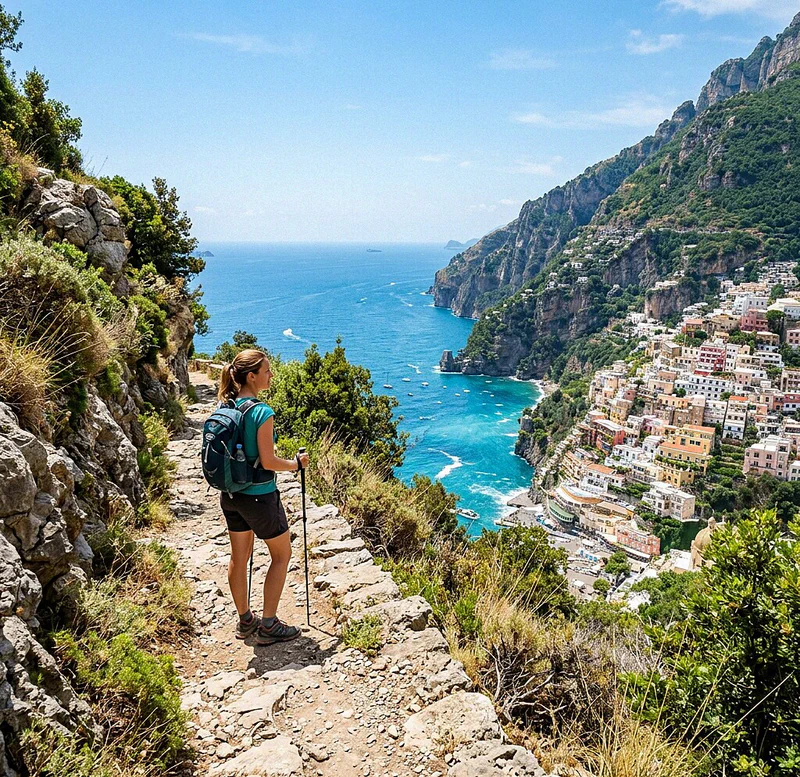
The Path of the Gods (Sentiero degli Dei): A Divine Revelation#
Let’s start with the undisputed king of Amalfi hikes: the Sentiero degli Dei. This path didn’t steal its name; it offers literally divine views that stretch from the island of Capri to Punta Campanella and beyond. It’s that rare sensation of floating between the sky and the sea.
My secret tip is to start this hike early, very early. Especially if you visit during May, June, or September. Not only will you beat the scorching midday sun, but you’ll witness the awakening of the coast, often shrouded in a soft mist that slowly thins to reveal the sparkling Tyrrhenian Sea.
How to Get There and Where to Begin#
The most popular starting point is Bomerano (40.628° N, 14.552° E), a hamlet of Agerola. You can reach Agerola by SITA bus from Amalfi. From the main piazza in Bomerano, follow the signs for “Sentiero degli Dei.” It’s well-marked, but keep an eye on the red and white CAI blazes.
For a true local experience, stop at Gastronomia Bomerano on Via Roma before you set off. Ask for a panino with local fior di latte cheese and artisanal cold cuts. It’s the perfect fuel for the journey.
The path typically leads you towards Nocelle, a tiny, car-free village perched high above Positano. From Nocelle, you have two options:
- Descend to Positano: Be warned, there are about 1,700 steps! It’s brutal on the knees, but the view of Positano appearing larger with every step is priceless.
- Continue to Montepertuso: A slightly less strenuous descent to another charming village, from where you can take a local bus down.
The main section from Bomerano to Nocelle is about 6.5 kilometers and takes roughly 3-4 hours. The terrain is undulating and rocky in parts: sturdy hiking shoes are non-negotiable.
Valle delle Ferriere: A Hidden Prehistoric Oasis#
If the Path of the Gods is about grand vistas, the Valle delle Ferriere is about entering a secret, almost prehistoric world. Tucked away behind Amalfi, this lush valley is a microclimate marvel, home to rare ferns like the Woodwardia radicans and ancient mosses, fed by waterfalls cascading over millennial rocks.
One of my biggest pet peeves? Seeing people arrive in Amalfi and never move more than a hundred meters from the sea. If only they knew what was up there! The Valle delle Ferriere is cool even on the hottest days of August.
Where to Begin#
The most beautiful way to access the valley is from Pontone (40.641° N, 14.605° E), a quiet village above Amalfi and Ravello. From here, follow the signs past fragrant lemon groves before the landscape transforms into a verdant gorge that looks like something out of a fantasy novel.
Alternatively, you can start right from Amalfi and hike up through the city’s ancient paper mills, following the Canneto River. It’s here that the famous Amalfi paper was once produced. If you love gravity-defying places perched on rocks, much like the floating fortress of Sant’Agata de’ Goti, the atmosphere of these jungle-shrouded industrial ruins will give you similar thrills.
Sentiero dei Limoni: Authentic Coastal Scents#
To taste the citrus culture of the Coast without too much effort, the Sentiero dei Limoni (Path of the Lemons) is a must. This relatively easy path connects the coastal towns of Maiori and Minori, winding through lemon terraces that seem to dive into the sea.
As you walk, you’ll be enveloped by the sweet and pungent scent of the “Sfusato Amalfitano,” the famous lemon unique in the world. You’ll see local farmers tending their trees, often using monorail systems to transport heavy baskets of fruit down steep slopes.
My secret tip: Once you arrive in Minori, go straight to Sal De Riso Pasticceria. Their lemon desserts are legendary, and a fresh granita there is the perfect reward after your aromatic walk.
Baia di Ieranto: The Frontier of Beauty#
If you really want to escape the mass and find a hidden gem, go to Nerano and look for the path to the Baia di Ieranto (40.578° N, 14.348° E). It’s a FAI (Italian National Trust) property and is the only way to reach a beach where boat engines are banned.
Update: The path starts from the village of Nerano and winds through olive groves and Mediterranean scrub. In front of you, Capri looks so close you could touch it. It’s a wild, silent, and absolutely magical place. If after so much effort you’re looking for a more refined refuge and a romantic garden to rest your eyes, my colleague Sofia has shared an enchanting guide to the gardens of Ravello.
Luca’s Practical Tips for the Perfect Adventure#
- Best Period: April, May, and June for blooms; September and October for still-warm sea and harvest. Avoid July and August: the heat can be brutal and the trails too crowded.
- SITA Logistics: Buses are your best friends but can be a torture (another of my pet peeves is overcrowded buses where you feel like a sardine in a tin). Try to move during off-peak hours and always buy tickets before boarding.
- Gear: Don’t be like those tourists I see climbing the Path of the Gods in flip-flops. Please! Hiking shoes, plenty of water, hat, and sunscreen.
- Eat Like a Local: Look for trattorias away from the main squares. In Atrani (just next to Amalfi) you’ll find places like Trattoria da Sara for no-frills local cooking. In Furore, Hostaria di Bacco is an institution for homemade pasta and incredible views over the fjord.
My final advice: Always carry a local snack. There’s nothing better than enjoying a piece of Provolone del Monaco watching the sun set behind Capri after a long walk. And if your spirit pushes you even further south, towards ancient history rising from the plains, my colleague Alessandro has revealed the magnificence of the temples of Paestum, a mandatory stop for those who love the charm of the past.
The Amalfi Coast on foot is more than just a holiday; it’s an immersion. It’s feeling the ancient stones under your feet, breathing wild rosemary, and discovering panoramas most visitors only dream of.
I hope to see you up there, where the sky touches the sea.