
There’s a running joke in Italy that “Molise non esiste”—Molise doesn’t exist. It’s the region everyone forgets, the one the high-speed trains bypass, and the one that remains blissfully ignored by the glossy travel magazines. But for me, that’s exactly why it’s paradise. While the crowds are currently elbowing each other for a glimpse of the Trevi Fountain or paying twenty Euros for a mediocre spritz in Venice, I’ve found myself back in the rugged, wind-swept heart of the Apennines.
I’m Luca, and today I want to take you to Pietrabbondante. Perched at an altitude of 1,027 meters on the slopes of Monte Caraceno, this isn’t just another hilltop village; it’s a place where the rocks themselves seem to breathe an ancient and fierce history.
If you’re looking for another dimension of Molise, more tied to the sea and family rituals, my colleague Elena has written an enchanting guide about the Festa dei Misteri in Campobasso. But if you want the rock and the myth, follow me up here.
The Sanctuary in the Clouds: The Samnite Parliament#
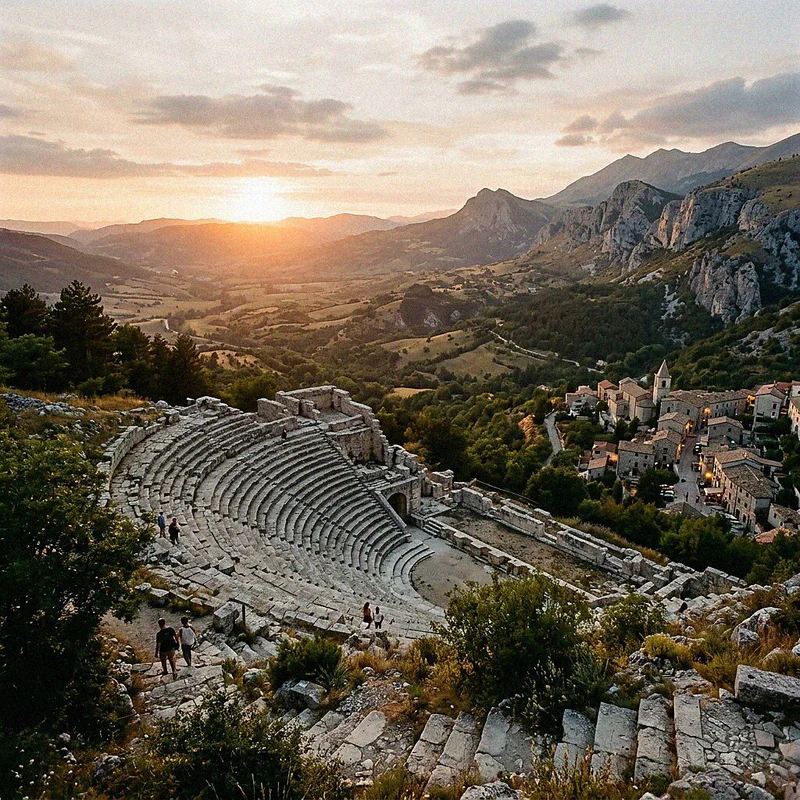
The crown jewel of Pietrabbondante isn’t a cathedral or a Renaissance palace; it’s the Area Archeologica, the Samnite Sanctuary of the Pentri. If you haven’t heard of the Samnites, don’t feel bad: history is written by the winners (the Romans), but these mountain people were the only ones capable of inflicting the humiliation of the Caudine Forks on Rome. Pietrabbondante was their spiritual and political heart, the place where they gathered to decide the fate of the Samnite nation.
Walking into the stone theater is a transcendental experience. Unlike Roman theaters dedicated to spectacle, this was a place of assembly. You’ll notice an incredible detail: the stone seats have anatomical backrests carved from a single block. My secret tip is to look along the blocks of the temple podium and on the seats for inscriptions in the Oscan language, the ancient idiom of the Samnites. Seeing those jagged characters still legible today makes you realize that Italy has roots much deeper and more diverse than what they tell us in school.
Living Among the Morge: A Challenge to the Sky#
The village of Pietrabbondante is literally fused with the morge, massive limestone formations that sprout from the ground like the teeth of a petrified giant. This gives the town a vertical, almost defiant feel towards the clouds. I spent hours getting lost in the steep alleys, eventually reaching the Church of Santa Maria Assunta at the highest point. The climb is a workout for the calves, but the panoramic view from up here, with the gaze sweeping to the peaks of Abruzzo, pays back every effort.
In the main square, the Warrior Statue dominates. It’s a bronze monument dedicated to those who fell during the Great War, but depicted with the armor of an ancient Samnite infantryman. It’s a powerful symbol: the warrior of 1915 re-linking to the warrior of the 3rd century BC, demonstrating that the soul of this land has been indomitable for millennia.
Flavors of Stone: Sagne, Beans, and Caciocavallo#
Nothing grinds my gears more than “English-only” menus or restaurants that display pictures of their dishes. That won’t happen here in Pietrabbondante. When it’s time to put your legs under the table, look for Trattoria da d’Abate. Here you eat like in the old days: portions that challenge gravity and ingredients that haven’t traveled more than ten kilometers.
Order the sagne e fagioli, a homemade pasta made with durum wheat flour, so substantial it could feed an entire Samnite army on the march. And don’t forget the caciocavallo di Agnone, produced in the nearby mountain huts: it’s a cheese with a strong character, spicy just right, perfect if accompanied by a glass of tintilia, Molise’s heroic grape variety.
Luca’s Pet Peeves: Molise is Not a Theme Park#
I want to share a huge pet peeve of mine: those who treat Molise with condescension, as if it were a “minor” region. Pietrabbondante has a historical dignity that many more famous art cities have sold out to mass tourism. It drives me crazy when people come up here and ask where the McDonald’s is or complain because the bars close for the afternoon rest from 1:00 PM to 4:30 PM.
Here the rhythms are those of the mountain. Respect them. If you’re looking for comfort at all costs, stay home. Pietrabbondante is for those who know how to wait for the sunset sitting on a stone wall, for those who know how to listen to the wind, and for those who don’t get scared if the GPS occasionally loses its signal among the limestone gorges.
Practical Tips: The Train Myth and the Real Cold#
- Logistics: Don’t be fooled by old maps: the “Pietrabbondante-Civitanova” station is a cathedral in the desert 15 km from the town, disused and with no shuttles. A car is mandatory.
- Winter: At 1,000 meters, snow isn’t a possibility, it’s a certainty. From December to March, don’t venture without chains or winter tires, or you’ll spend the night in your car contemplating the stars (which are beautiful, though).
- Secret Tip: If you have time, jump over to Agnone, just a few minutes away by car, to visit the Marinelli Bell Foundry, the oldest bell factory in the world. It’s an experience that will make you understand why this area is the beating (and ringing) heart of Italian craftsmanship.
Pietrabbondante is the Molise that doesn’t exist for those in a hurry, but that shines with its own light for those who know how to look beyond the asphalt of the highways. It’s a place of limestone, legends, and some of the best pasta you’ll ever eat in your life. And if after breathing the thin mountain air you feel the call of the sea, know that Molise can also be an infinite horizon: my colleague Sofia has recently published a romantic guide to Termoli, the jewel of the Adriatic. If you wish to head even further South towards the heel of Italy, don’t miss my authentic itinerary in Salento.
Stay indomitable.
Stay curious, Luca