
Laced boots and black coffee. While the valley still sleeps under a blanket of icy mist, I’m already treading the first snowfield toward the ridge. I’ve spent twenty years measuring Italy in meters of elevation gain, from the grey walls of the Dolomites to the dusty trails of the Gennargentu. I’m not here to sell you a glossy brochure, but to take you where oxygen is scarce and the rock has a voice. Get ready to sweat.
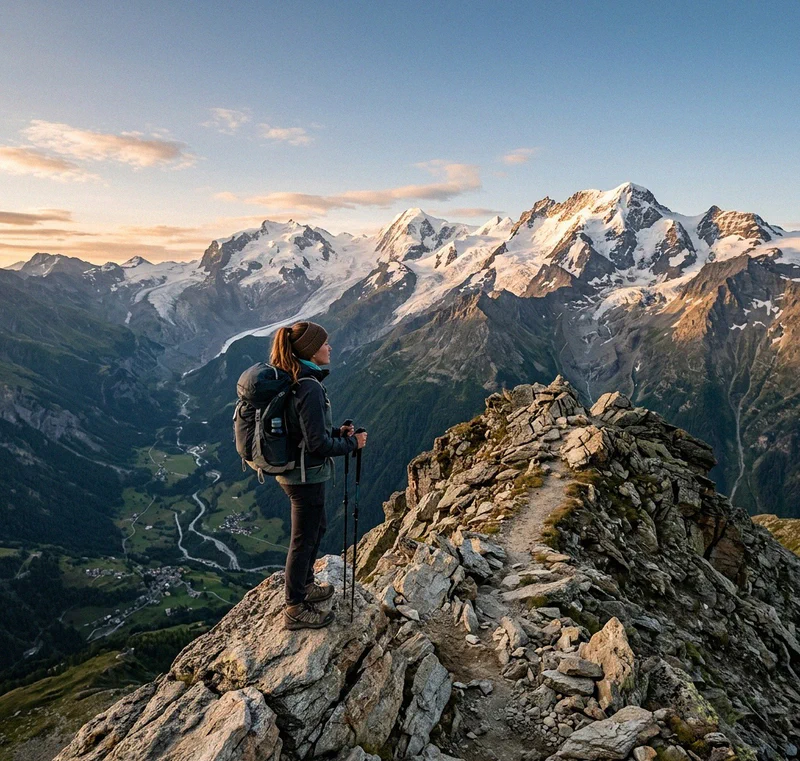
Today we set our sights on the Monte Rosa massif, the ice giant that dominates the northern horizon. Forget the crowded cable cars and selfies on the easy glacier: we will immerse ourselves in the lesser-known folds of Valle d’Aosta. We will explore the Lys Valley, the Val d’Ayas, and those corners of Valtournenche where the whistle of marmots drowns out the noise of the world. If you are looking for a softer and more romantic experience, I suggest the story of my friend Sofia on moonlit skiing in Courmayeur. But if you want to feel the cold breath of the glaciers on your skin, follow me.
Respect for the Summit: High Mountains Do Not Forgive#
The mountain is not a playground. Here, Instagram filters don’t count; only the strength of your quads and the quality of the technical shell in your backpack matter. The weather at three thousand meters changes in the blink of an eye, turning a sunny afternoon into a hell of sleet and freezing wind. I’ve seen too many tourists head up in sneakers, ignoring that wet granite has the same grip as live ice. Respect the peaks or stay in the valley.
Martina’s Kit for 2,500 Meters#
- Leather or Technical Synthetic Boots: Rigid Vibram sole to avoid slipping on wet rock.
- Layering System: At least three layers, including a high-quality Gore-Tex jacket.
- Map and Compass: The cold drains a smartphone in half an hour; paper doesn’t need batteries.
- Genepy in the Pack: A sip to celebrate at the top, never during the climb.
The Lys Valley: The Walser Soul Between Ice and Wood#
In Gressoney, the scent of burning wood mixes with the crisp air descending from the Lyskamm. Here, Walser architecture is not a museum but a testament to extreme survival that has lasted for centuries. The Stadel, wooden houses raised on stone “mushrooms,” served to keep rodents away from grain and allow air to circulate to dry the rye. Walking among these hamlets means listening to the echo of an ancient language, Titsch, which still resonates on winter evenings. A heritage carved in larch.
Trekking to Alpe Valdobbia and the Alpenzu Refuge#
The Colle Valdobbia is a wound in the sky. the climb is a journey through time along the route that connected Valle d’Aosta to Valsesia for the cattle trade. If you are looking for total immersion in the Walser world, head for the Alpenzu Grande Refuge, a suspended plateau where time stopped in the 1600s. The “polenta concia” served here tastes of alpine butter and real toil. It is the prize of the righteous.
Val d’Ayas: Where the Asphalt Ends and Silence Begins#
Beyond Champoluc, in Saint-Jacques, the road dies against the mountain and the heart’s rhythm must adapt to the slope. It is a valley of light and turquoise waters, where torrents fed by glaciers sing a constant melody. Here the trail narrows, and the intense scent of wet larch will accompany you up to the high pastures, where the air tastes of ancient snow. The rock turns dark as you approach the border with the clouds. The silence here is absolute.
The Ascent to Colle Salza: For Trained Legs#
This is a severe itinerary. The green of the pastures abruptly gives way to grey and desolate scree that looks like it belongs to another planet. Reaching Colle Salza means coming face-to-face with the west face of Castor, a wall of ice that takes your breath away. The Ferraro Refuge in Resy is my safe harbor for the return, with its rough and genuine hospitality. It is rock that warms the soul.
Valtournenche: The Sentinel of the Matterhorn#
You cannot talk about Monte Rosa without mentioning the valley that divides it from the “Gran Becca,” the Matterhorn (Cervino). The trek toward the Duca degli Abruzzi Refuge at Oriondé is an open-air mountaineering history lesson. You are on the path of the pioneers, surrounded by walls that saw the birth of the myths of the world’s most iconic mountain. The clink of crampons on the backpack of a climber returning from the summit is the perfect soundtrack for this ascent. History is breathed here.
The Ultimate Dream: Capanna Margherita#
For those who are not afraid of heights, Monte Rosa guards the Capanna Margherita (4,554 m), the highest refuge in Europe. It is not a trek; it is a mountaineering ascent that requires a guide, crampons, a rope team, and lungs of steel. It is a sentinel in the sky where the dawn sets the glaciers ablaze with colors that do not exist in the lowlands—an explosion of pink and orange. It is the “ultimate dream,” a place where the border between earth and sky becomes as thin as a silk thread. Touching the sky has a price.
Logistics and “Insider Downsides”#
Reaching the heart of Monte Rosa is not for those who love modern comforts. The A5 motorway takes you to Verrès, but from there on, it is a festival of narrow hairpins that will test your brakes and your patience. Regional VITA buses are punctual but rare: miss the last one and you’ll be forced into an improvised bivouac or a very expensive taxi. Prices at high altitude are as salty as Lardo d’Arnad, but remember that every sugar cube arrived up there by helicopter. Nothing is free up here.
Recovery: Flavors That Warm the Soul#
After ten thousand steps, the body demands serious fuel. Alpine Fontina, the real kind that smells of the stable and mountain flowers, is the undisputed queen of the Val d’Aosta table. Try the Chnefflene, small Walser dumplings with cheese and caramelized onions, because they are a necessary calorie bomb for the descent. Always close with the Coppa dell’Amicizia (Friendship Cup), but make sure someone else drives you back down to the valley. Fatigue vanishes in the taste.
If these flavors have piqued your curiosity, don’t miss Giulia’s culinary journey through the Walser gastronomic traditions. It is the perfect complement to understanding how these people managed to thrive among the ice for centuries.
Take away only photos, leave only footprints, and don’t forget to greet those you meet on the trail. The mountain is a silent temple.
See you soon, Martina