
There is one day a year when Venice’s Grand Canal stops being a highway for water buses and taxis and returns to being what it has been for a millennium: a vital artery moved only by the strength of arms and the love for the lagoon. That day is the Vogalonga.
But May 24, 2026, will not be a Sunday like any other. This year the Vogalonga celebrates its 50th anniversary, a monumental milestone that transforms what was born as a peaceful protest into one of the world’s greatest manifestations of cultural and environmental resistance.
I am Alessandro, and as a historian, I have always looked at the Vogalonga not as a simple regatta, but as an act of collective love towards a city that fights every day for its dignity. Participating in or attending the 50th edition means being a witness to a rite that blends sport, tradition, and a desperate but joyful appeal for sustainability.
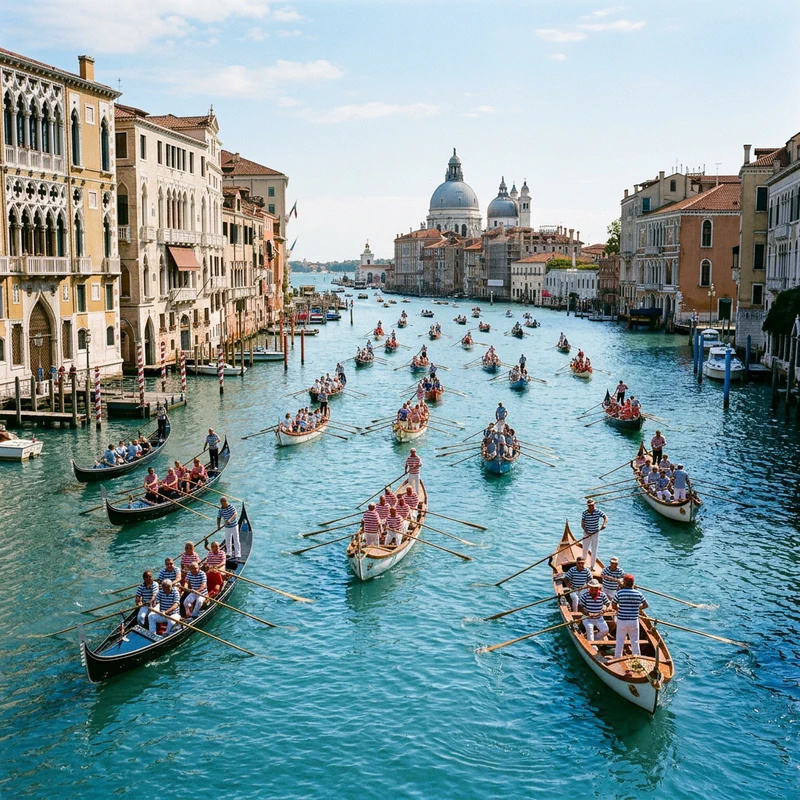
In this article, I want to take you into the heart of this event, revealing its deep roots and the secrets to experiencing this historic anniversary as a true insider.
1974: The Birth of a Rowing Protest#
To understand the importance of the Vogalonga, one must go back half a century. In 1974, a group of Venetian friends – led by historical figures such as Lauro Bergamo and Rosa Salva – decided that the time had come to say enough. The “moto ondoso” (wave motion) caused by motorboats was literally eating away at Venice’s foundations, and the tradition of voga alla veneta was disappearing, crushed by modernity.
The first official edition, in 1975, was a surprise to everyone: thousands of Venetians dusted off old family boats – sandoli, mascarete, and caorline – to reclaim the water space that had been taken from them.
It was not a race for who arrived first. It was (and still is) a non-competitive parade where the only prize is the participation medal and the honor of having contributed to keeping the city alive. This dedication to the preservation of the purest traditions is a trait I have often found in my travels, where the recovery of an ancient art becomes a political act. (If you love stories of those who defend authenticity against standardization, I recommend reading my in-depth look at the Festa di San Pietro in Venice, another moment when the city returns to the Venetians).
Voga alla Veneta: An Art of Balance#
Participating in the Vogalonga requires considerable physical and technical preparation. Voga alla veneta is not the rowing we see at the Olympics. Here you row standing up, looking forward, becoming one with the boat. It is a technique of perfect balance between the push of the oar and the sliding on the hull, designed for navigating the shallow and treacherous waters of the lagoon.
For the 30 kilometers of the route, the rowers must manage currents, wind, and fatigue, maintaining a constant rhythm that is almost hypnotic. Seeing the larger boats, like the “Dodesona” with twelve rowers in perfect synchronization, is a spectacle of coordination that leaves you breathless.
The 30 Km Route: Through the Silence of the Lagoon#
The route of the Vogalonga is a masterpiece of lagoon geography. It starts with the roar of a cannon shot in the St. Mark’s Basin, right in front of the Doge’s Palace, in an explosion of colors and shouts of joy.
The fleet then heads towards the northern islands:
- Vignole and Sant’Erasmo: where you can breathe the air of “peasant Venice.”
- Burano and Mazzorbo: with their colorful houses reflecting the morning light.
- Murano: the island of glass, where the workshops stop to applaud the passing of the boats.
But the most dramatic and magical moment is the return to Venice through the Cannaregio Canal. Thousands of people crowd the bridges and foundations to welcome the exhausted rowers. The sound of oars hitting the water and the shouts of encouragement create an electric atmosphere. If you are visiting Venice with your children during this weekend, the Vogalonga is the perfect opportunity to show them that the city is not a museum, but a living place. (Speaking of family logistics, my colleague Elena has prepared a valuable guide on how to manage Venice with kids without stress).
The 50th Anniversary: What to Expect in 2026#
For the fifty-year milestone, the organizing committee has planned special events that will last for the entire week leading up to May 24th. There will be historical exhibitions with photos of the first editions, free voga alla veneta workshops for young people, and traditional music concerts along the canals.
Participation expected for 2026 is record-breaking: over 2,000 boats are expected from every corner of the globe. You will see Polynesian canoes, Chinese dragon boats, English kayaks, and even home-built boats, all united by the same spirit of water brotherhood.
Alessandro’s Travel Tips for the Conscious Traveler#
Experiencing the Vogalonga as a spectator requires a small strategy to avoid the crowds and enjoy the best moments.
- The Observation Point: The Three Arches Bridge is iconic but extremely crowded. If you want a more intimate experience, take an early morning vaporetto to the island of Murano (Faro) and watch the passage of the fleet in the central canal. It is a moment of pure magic before the final hustle and bustle.
- The Venetian Breakfast: Stock up on energy with a “tramezzino” or typical “cicchetti” in one of the osterie of Cannaregio before the arrival. It will be your lifeblood while waiting for the passage of the boats.
- Respect for the Water: Remember that the Vogalonga is a hymn to sustainability. If you are a spectator, make sure you don’t leave waste along the foundations and respect the areas marked for the rowers’ safety.
This search for a harmonious bond with the territory, between effort and beauty, is the same that we find in other historic Italian manifestations that have known how to preserve their integrity. (If this spirit of conservation fascinates you, I invite you to discover my post on Sabbioneta, the ideal city, another place where human vision has created a perfection that defies time).
The Vogalonga is not just a party; it is a promise. The promise that as long as there is a Venetian ready to hold an oar and a guest willing to respect the silence of the lagoon, Venice will never sink.
See you in St. Mark’s Basin, Alessandro