
Gargano in March is not for Sunday tourists. While the rest of Italy still waits for the sun, here the arid prairies explode in a bloom that has no equal in all of Europe. I walk among the limestone paths of Mattinata, where the air smells of wild thyme and wet rock, trying not to step on the botanical miracles of the park. You can feel the biting wind rising from the Adriatic as your boots bite into the sharp gravel without hesitation. It is pure botanical resilience.
This is my spring trekking paradise: a labyrinth where the silence is broken only by the rustle of dry leaves. I’m speaking to you as someone who has learned to respect the mud and the stone, because the mountain makes no concessions to those who approach it lightly. Every step requires surgical attention and eyes wide open for the over 90 species of orchids that color the grey limestone. I feel the effort in my lungs filling with pure oxygen, while the morning’s low light carves the profiles of the cliffs. Nature is in charge here.
Technical Data: The Ancient Ways (Mattinata - Monte Sant’Angelo)#
- Difficulty: EE (Expert Hikers - uneven limestone terrain and significant elevation gain)
- Elevation Gain (D+): 815 meters
- Distance: 14 km (one way) / 22 km (full loop)
- GPS Coordinates (Trailhead): 41°42'54"N 16°03'24"E
- Water Points: None on the trail. Refill abundantly in Mattinata.
The Pilgrim’s Path: Between Fault Line and Faith#
The path connecting Mattinata to Monte Sant’Angelo is not a climb to a summit, but a spiritual and geographical ascent towards one of the most sacred places in Christianity. You will walk along Valle Carbonara, an imposing tectonic fault that divides the Gargano and offers a unique perspective on the promontory’s geology. Feel the breath of history under your feet as you walk along the sections of the Via Francigena del Sud, the Via Michaelica that for centuries has seen pilgrims heading to the Grotto of the Archangel. It is a path carved into the rock, witness to a devotion that has shaped the landscape. It’s worth every ounce of effort.
Arriving at Monte Sant’Angelo, perched at over 800 meters, welcomes you with the blinding white of the Junno district and the mystical silence of the Sanctuary of San Michele (UNESCO World Heritage). Walking among its Lombard crypts, where naked rock merges with sacred architecture, gives a sense of peace you won’t find elsewhere. I often stop to observe the Gulf of Manfredonia opening up below the town, a blue expanse that seems infinite. History here isn’t read, it’s walked upon. The physical effort is your tribute to the place.
If you appreciate the white architecture and millenary silence of this area, you will find a similar soul in this road trip through the Valle d’Itria, where history and stone perfectly merge. It is a perfect harmony that unites the north and south of our region into a single limestone thread. A necessary integration: for those who want to tame these roads by car instead, Marco has mapped an automobile itinerary on the Gargano that touches the wildest cliffs. It is the ideal combination.
Monte Saraceno: The City of the Dead Overlooking the Blue#
Not far from Mattinata, the Monte Saraceno trail offers a detour that Martina highly recommends for its heavy load of suggestion and ancient history. Here lies the Daunian Necropolis, with hundreds of tombs carved into the limestone rock looking out towards the Adriatic Sea. Walking among these millenary burials, surrounded by the scent of Aleppo pines and the perfect mimicry of wild orchids, is an exercise in humility. Feel the contrast between the eternity of the stone and the fragility of the flowers that bloom among the rocks. The view is breathtaking.
Perfect Mimicry: The Deception of the Ophrys Garganica#
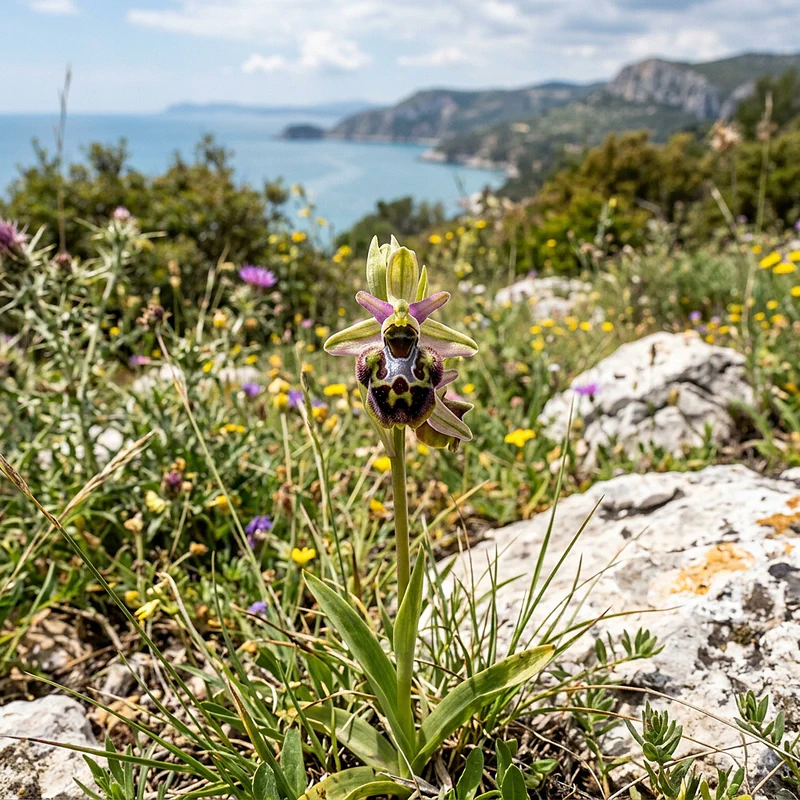
The wild orchid is a master of deception and survival in conditions that would be an understatement to call prohibitive for any other plant. The Ophrys garganica, endemic to this promontory, has evolved a labellum that perfectly mimics the body of a female insect to attract male pollinators. It is fascinating to observe how every single vein and shade of color serves to ensure the continuation of a species that defies the aridity of the rock. I lower myself almost to touch the ground to photograph these infinitesimal details that escape the distracted gaze of hurried tourists. Mimicry is art.
It deeply irritates me when people lie on the meadows without looking where they put their feet just to take a selfie to publish on social media. These precious plants take years to bloom and a single careless step can destroy an entire life cycle established over time. You must move with surgical precision, staying strictly within the paths traced by shepherds and the expert hikers who preceded us. The mountain doesn’t care about your followers and has no time for those who don’t know how to respect silence. Stay on your path.
From Rock to Beech: The Contrast of the Foresta Umbra#
If your legs can handle the impact with the stone, push towards the interior to experience the brutal contrast between the coast and the Foresta Umbra. Here the beech reigns supreme at unusually low altitudes, creating a green cathedral that seems to belong to much more northerly latitudes than Puglia. Feel the musky and humid smell of the earth waking up under the layer of dry leaves that cushions your every solitary step. The temperature change is sudden and requires intelligent management of the technical layers you decided to pack. It is a primordial lung.
My second great grievance concerns those who shout along the trails or listen to loud music, disturbing the delicate balance of the local fauna. You enter the Forest in tip-toe, listening to the creaking of branches and the call of the Italian roe deer that inhabits these hidden valleys. I often stop to close my eyes and let the sounds of the woods guide my perception of the surrounding space. The wild nature doesn’t need your playlist or your shouts to be appreciated in all its power. Listen to the silence.
Technical Gear: Leave Nothing to Chance#
Gargano is a land of karstic rock that does not forgive errors of judgment or the improvisation of Sunday hikers. I highly recommend boots with high-traction Vibram soles, because wet gravel can become a slippery and dangerous trap in just a few minutes. Ankles must be protected by high-cut boots to avoid sprains on a terrain that is constantly irregular and sharp. Don’t forget a high-quality technical windproof jacket (a “shell”): on the ridge of Monte Sant’Angelo, the gusts can be brutal. Always be prepared.
Take at least two liters of water with you, as natural springs on the trail are practically non-existent during the spring season. A first aid kit and an offline GPS track are indispensable tools, as cell coverage in the heart of the park is often intermittent or absent. I always make sure the backpack is balanced correctly so as not to overload my back during the steepest and most exposed sections of the climb. Never look for shortcuts off the trail, as the risk of getting lost or injured among the karstic hollows is real. Prudence pays off.
The Flip Side: The Price of Wild Beauty#
I must warn you that logistics in this area can be complicated and require planning that goes beyond the simple map of the trails. Parking near the trailheads in Mattinata is a logistical nightmare on blooming weekends, when the local police have no mercy whatsoever. Fines for those who invade the ZTL (limited traffic zone) or park outside the allowed spaces are very steep and can ruin the mood of an entire day of freedom. Arrive at dawn to secure a safe spot and enjoy the best light for your macro photographs of the orchids. Plan ahead.
Another weak point is the almost total absence of equipped public toilets along the coastal roads leading to the trekking starting points. Make sure to have a technical stop in the bars of Mattinata or Monte Sant’Angelo before lacing up your boots and starting your ascent towards the town. Often the signage for minor trails is not updated, making the use of a compass or a good updated CAI paper map fundamental. The beauty of Gargano has a price made of small logistical inconveniences that must be faced with patience and spirit of adaptation. Be a true connoisseur of the place.
Living Gargano in March means accepting the challenge of effort to conquer panoramas that smell of the sea and ancient rock. Lace up your boots tight, tighten your pack, and let yourself be guided by the ancestral hiker’s instinct among these meadows that seem painted by an invisible artist. The reward is not a medal, but the feeling of having breathed together with the mountain in its most intimate and vibrant moment. The journey has just begun.
Happy hiking,
Since writing this, I’ve had the opportunity to discuss the beauty of Veneto with my colleague Luca, who recently published a guide to the hidden lagoons of this incredible region, often overlooked by tourists. Exploring Veneto’s Secret Lagoons reveals the serene landscapes and tranquil waters that make this area truly unique.