
If you think Puglia is just sun, sea, and trulli, get ready to change your mind. There’s a wild, unexpected side that transforms into a true sanctuary of peace in winter: the Foresta Umbra in the heart of Gargano.
We’re talking about a UNESCO Heritage Site, a green cathedral that, under a blanket of snow, reveals an austere and powerful beauty. Forget the crowds, here you’ll find only the rustling of the wind and your own breath.
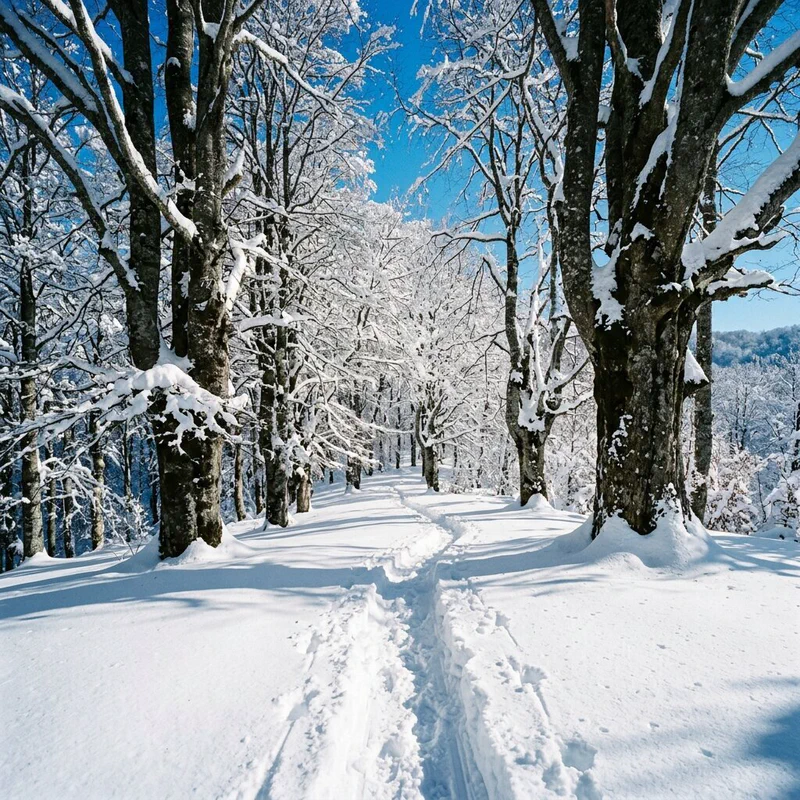
It’s an experience that challenges you and rewards you, a total immersion in the purest nature. The air is crisp, the silence is deafening, and every step in the silent woods is a discovery. It’s not just a walk; it’s an adventure that requires preparation and respect. But I assure you, it’s worth every single drop of sweat.
Why the Foresta Umbra in winter?#
The Foresta Umbra, at about 800 meters above sea level, is a jewel of the Gargano National Park. In winter, its ancient beech forests, a UNESCO heritage site, dress in white, creating fairy-tale landscapes. There’s a reason why its name comes from the Latin umbra (shadow, darkness): the canopies of the beech trees are so majestic and dense that they hardly let sunlight through, creating a suspended and muffled atmosphere. Consider that in 2022, it was even elected by an international jury as one of the ten most beautiful forests in the world – the only Italian one to enter this prestigious ranking. Moreover, thanks to this recognition and the Sanctuary of San Michele in Monte Sant’Angelo, Gargano is one of the few areas in Italy to boast two UNESCO heritages in the same territory.
It’s the perfect time to explore it on foot or with snowshoes, away from the summer bustle. Here, you can really connect with nature, listen to its rhythms, without distractions. This forest stretches over 10,000 hectares, a vast expanse of green (or white, in winter!) that covers part of the municipalities of Vico del Gargano, Monte Sant’Angelo, Vieste, Carpino, and Peschici.
Despite being a short distance from wonderful villages like Monte Sant’Angelo and Vieste, once inside, you’ll be isolated from the noise of the world. You’ll find yourself in the deep heart of Puglian nature, surrounded by a muffled silence and centuries-old beech trees that seem to touch the sky.
Winter trekking and excursions: technical details#
Do you always need snowshoes? Let’s clarify: absolutely not. Gargano is still in Puglia, and abundant snow is not a constant seasonal feature. In the last twenty years, significant snowfalls capable of depositing over 30-50 centimeters of fresh snow have occurred only 5 or 6 times (like in the memorable winters of 2012, 2017, and 2018), concentrated in brief time windows of a few days. In those rare magical moments, snowshoes are indispensable to avoid sinking. In ordinary weeks when snow is absent or there’s only a superficial layer, snowshoes would be completely useless and cumbersome: the same identical routes can be tackled magnificently on foot with normal trekking boots. Always call the Visitor Center or contact local guides to verify the actual snow conditions before setting out!
The Foresta Umbra trails are generally well-marked, but with snow, reading the trail requires attention. There are no specific CAI levels for winter snow hiking, but consider a difficulty level of E (Hiking) for most trails.
This means they are paths on varied terrain, requiring a minimum of training and the ability to orient yourself. The average altitude of 800 meters guarantees moderate but constant slopes, perfect for cardiovascular training. Given the karst nature of the subsoil, you won’t find large natural lakes, but the Laghetto Falascone is a serene oasis worth visiting.
I recommend starting from the Visitor Center; there, you’ll find maps and can ask for updated information on snow conditions. From there, several loops depart that wind through the monumental beech trees.
- Suggested Winter Routes:
- Laghetto Falascone Loop: A shorter and less demanding route, ideal for getting familiar with the snow-covered trails. It takes you to the serene Laghetto Falascone (also known as Laghetto d’Umbra), a small body of water that can be partially frozen in winter. Nearby, you’ll also find the Deer Enclosure and the Gio Bosco playground.
- Cutino di Scaranappe Trail: A fascinating detour that leads to an old artificial water pool surrounded by historic dry stone walls. When it rains or the snow melts, the “cutino” fills up, taking on a suggestive heart shape.
- Faggeta Vetusta Trail: Longer and with a few more ups and downs, it immerses you in the heart of the UNESCO heritage. Here, the silence is almost palpable, and the feeling of being one with nature is priceless.
How to dress: my equipment for Gargano snow#
We’re not talking about climbing the Alps, but the Foresta Umbra in winter has a unique microclimate that holds great surprises. Even at 800 meters of altitude, the humidity of the nearby Adriatic Sea clashes with the cold currents coming from the Balkans, giving abundant snowfalls and a damp cold that penetrates to the bone if you’re not prepared. Forget heavy, padded ski suits, which would only make you sweat during the effort. The keyword here is dynamism, preferring light and modular layers.
In my winter excursions, I always choose technical equipment aimed at what I’ve proven on my own skin:
- The protective shell: More than a padded jacket, I prefer a waterproof and windproof shell. When walking under the monumental beech trees, the heat of the sun melts the accumulated snow on the canopies, creating a constant and icy drizzle that falls from above. A good, breathable shell keeps you dry without overheating.
- Gaiters (my true lifesaver): If there’s an accessory I never give up, it’s snow gaiters. Gargano is a karst territory rich in dolines and small depressions where fresh snow accumulates easily, exceeding half a meter. Without gaiters, snow inevitably enters your boots with every deep step, soaking your socks. And I assure you that having wet feet at zero degrees is the quickest way to ruin your excursion.
- High trekking boots: Absolutely rigid and waterproof, with a well-sculpted sole to securely attach snowshoes (which you can easily rent in nearby villages or at the visitor center if you don’t own them). Leave soft boots or low gym shoes at home.
- A small warm comfort: In my backpack, there’s always space for a thermos with warm rose hip and ginger infusion. Enjoying it seated on a snow-covered trunk near Laghetto Falascone, surrounded by total silence, is one of the greatest feelings of peace I know.
- Poles with a wide wheel: Indispensable for maintaining balance on fresh snow and for probing the ground, avoiding tripping over hidden branches or rocks under the white blanket.
Finally, always carry a small bag to bring back your trash. Let’s respect this natural sanctuary and leave only the prints of our snowshoes.
A pinch of history: the “ghost” railway of the Foresta Umbra#
There’s a hidden historical secret among the monumental beech trees that many hikers completely ignore. Between the late 19th and mid-20th centuries, this unspoiled forest was a nerve center for timber exploitation. To transport logs to the sawmill in the Mandrione area, an incredible narrow-gauge railway of the Decauville type was built.
The peculiarity of this railway line? It was powered entirely by gravity! The wagons loaded with heavy logs were braked by hand by brave workers and descended along the tracks using exclusively the natural slope of the terrain, without the need for any locomotive for the descent. Once emptied downhill, they were pulled back up by mules. Today, the tracks are gone, but walking along some trails, you can still spot the old, flat embankments that testify to this incredible feat of human ingenuity.
How to get to the Foresta Umbra: forget public transport#
Reaching the Foresta Umbra in winter requires a car. Don’t expect train or bus connections: public services to the heart of the reserve are practically non-existent or impractical in this season.
- By Car (Obvious Choice):
- From the North: Take the A14 Adriatic highway, exit at Poggio Imperiale-Lesina, and take the Gargano superhighway towards Vico del Gargano. From there, follow the clear signs to Foresta Umbra.
- From Vieste: Travel on the SS 89 for about 9 km, then turn onto the SP52 Bis towards Monte Sant’Angelo.
- Winter Tip: The roads that climb to high altitude can be snowy or icy. Make sure you have winter tires or certified snow chains on board.
Where to eat and sleep: my recommendations#
After a day in the snow, there’s nothing better than a warm meal and a cozy bed. Gargano knows how to pamper its adventurers.
- Trattoria Foresta Umbra: Located in Baracconi FG, it’s a must-visit. It offers authentic homemade cuisine. Imagine a steaming plate of pasta or a sandwich with porchetta after hours of walking in the cold! I recommend booking, especially on weekends.
- Agriturismo Azzarone: Near Vieste and on the edges of the forest, it offers both accommodation and excellent Puglian cuisine, often with zero-kilometer products. An excellent base for exploring the area.
- Monte Sant’Angelo: This historic village, with its Sanctuary of San Michele Arcangelo (UNESCO site), offers various dining and accommodation options, a short distance from the forest. It’s a magical place to explore even without snowshoes.
Martina’s practical tips#
Listen to me, these are the tips that only someone who lives and breathes these mountains will give you.
- Check the Weather: Winter conditions can change rapidly. A snowfall can make some trails impassable or dangerous.
- Start Early: The days are short. Begin your excursion in the morning to have enough light and avoid finding yourself in the dark.
- Don’t Underestimate Orientation: Even if the trails are marked, with fresh snow, the tracks can disappear. Don’t rely solely on your phone; bring a paper map and a compass.
- Total Disconnection: Phone and internet coverage inside the forest is almost non-existent. Take this opportunity for a healthy digital detox in nature, but download offline maps before setting out.
- No Public Bathrooms: Remember that within the reserve, you won’t find public restrooms. Plan your stops by relying on commercial activities in the area, such as the Bar Cantoniera or Trattoria Foresta Umbra.
- Dogs on a Leash and Wild Fauna: If you decide to walk on the snow with your dog, keep it strictly on a leash. The forest hosts precious and delicate fauna, including the autochthonous Italian Roe Deer (a very rare subspecies of the Gargano) and wolves, which could be frightened or injured.
- Respect the Silence: The magic of winter in the Foresta Umbra is its silence. Savor it.
- Share the Journey: If you set out with friends, use just one car. Fewer vehicles, less impact, and more fun.
Remember, the true wealth of these places is not measured in likes, but in the sensations they leave inside you. It’s worth every single drop of sweat and every snowflake that caresses your face. And for winter trekking enthusiasts, remember: slow steps, one trail, and no distractions.
Ready for the adventure?#
Exploring the Foresta Umbra in winter is an experience that reconnects you with yourself and with the most authentic nature. It’s the Puglia you don’t expect, wild, silent, and incredibly beautiful.
If you love walking in the wild nature of Gargano, don’t miss my itinerary dedicated to wild orchids of Gargano, a true spring wonder. If instead you want to move south for a different coastal adventure, the guide to discovering the lesser-known Salento is a great resource.
Update: My colleague Giulia recently explored the authentic side of Verona’s wine scene, and I’m thrilled to learn from her expertise. Since writing this, Giulia shared her insider knowledge on Vinitaly for foodies, highlighting the best authentic osterie in Verona to escape the crowds and indulge in divine local cuisine. If you’re looking for adventure on snow-covered trails, maybe we’ll cross paths at dawn this year!